
Why are English teams dominating European football?
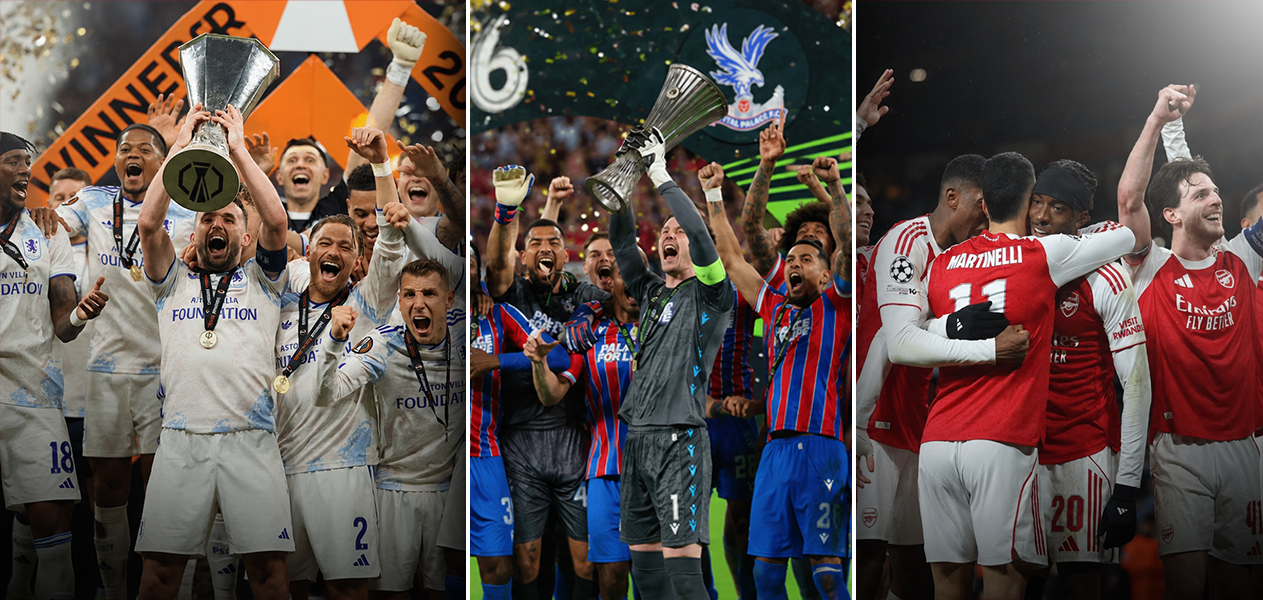
Premier League clubs have shown an impressive dominance in European competitions this year. Aston Villa won the Europa League, Crystal Palace won the Conference League, while Arsenal have finished runners-up in the Champions League.
The writing on the wall couldn’t be clearer: English teams are set to rule Europe for the foreseeable future.
Tottenham Hotspur’s Europa League triumph in 2024/25, Manchester City winning the Champions League in 2022/23, and West Ham winning the Conference League the same season are further proof of the same argument. Chelsea (2020/21) and Liverpool (2018/19) have also won the Champions League in recent years.
This is a stark contrast to the times when teams from Spain and Italy were dominating European competitions. Even though Real Madrid remain the standout team in the Champions League with the most titles (15 titles), followed by AC Milan (seven), their dominance is starting to wane, with English sides reaching more finals and winning European competitions more regularly.
So, it begs the question: why? What could have led to this transformation? Is it a healthy trend for European football? And what could be done to make things more competitive?
Here, we look at the decisive factors that have led to this stratospheric transformation.
Financial power
It’s a well-known fact that the Premier League’s financial power is unmatched across Europe. Due to its popularity around the world, the league generates the highest broadcasting and commercial revenues.
As per Deloitte UK, six Premier League sides rank in the top ten of the Deloitte Football Money League as the top revenue earners in 2026, and almost 50% of the top 30 come from the English top flight. Premier League teams have also been the highest spenders in Europe, with the 2025 summer window exceeding an outrageous €3.7 billion in summer signings, way more than the combined spending of the German Bundesliga, LaLiga, Ligue 1, and Serie A clubs.
The massive broadcasting revenues are shared among the Premier League clubs, making for a sizeable income for these clubs, further enabling even mid-table sides to outspend many traditional European giants from the other leagues. As a result, English teams are capable of acquiring the best talent while also maintaining squad depth to manage the workload of several domestic and European competitions.
For further context, even mid-table teams like Crystal Palace are able to spend over £80 million in the 2025/26 season, while the team they beat in the Conference League final this year, Rayo Vallecano, could only spend about £7 million (as per Transfermarkt). That is a huge margin, further showcasing English clubs’ ability to acquire more talented players, build better-quality squads, which ultimately leads to frequent silverware.
Squad depth and rotation
English teams tend to have relatively higher workloads in comparison to the other leagues, as apart from the Premier League and European competitions, they also participate in two domestic competitions: the League Cup and the FA Cup. As a result, the fixture congestion requires top clubs to play almost every three days, while even mid- to lower-table clubs have to learn how to manage their squads.
The bigger a team’s ambitions, the bigger and more talent-stacked their squad needs to be, making sure there’s enough quality on the bench to see them through the rigorous fixture schedule. Due to their current financial superiority, they are able to do so, as we saw how Arsenal invested in a quality squad in the summer ahead of the 2025/26 season, which helped them ably compete on all fronts; they won the Premier League title and reached the Champions League and League Cup finals while dealing with injuries due to excellent squad rotation. The same goes for Manchester City, who won two domestic trophies and pushed Arsenal for the league title until the very end.
Teams in other top leagues are not used to rotating as heavily as English teams are, so when injuries pile up and fixtures come in thick and fast across multiple competitions, they’re more likely to falter under pressure.
Competitiveness in the league
As we recently witnessed throughout the 2025/26 Premier League season, the physicality and competitiveness among clubs were at the highest level. With the league title won with 84 and 85 points respectively in the last two seasons, things are tighter than they have been in recent years.
The traditional “Big 6” clubs — Arsenal, Liverpool, Man City, Man United, Chelsea, and Spurs — are no longer guaranteed the top spots, as teams like Aston Villa and Newcastle United have produced consistent performances and qualified for Europe more often than the likes of Chelsea, Man United, and Spurs, who have fared poorly in recent seasons. Other mid-table teams like Bournemouth, Brighton & Hove Albion, and Nottingham Forest have made successful bids for Europe through the league, highlighting the division’s unpredictable and highly competitive nature.
If we compare this to LaLiga, Serie A, the Bundesliga, or even Ligue 1, most teams at or near the top this season were the usual suspects, barring a few exceptions like Getafe in Spain and Lens in France, with teams in the lower half now being able to show improvements or take massive strides like their Premier League counterparts.
Moreover, with the playing style being more physical and intense in the Premier League, English teams are better prepared to handle opponents from other leagues. While the likes of PSG, Barcelona, and Real Madrid are still incredibly difficult to play against, Premier League sides are better equipped to handle a more open playing style in Europe compared to the tight and cagey domestic encounters.
Hence, the playing style and the intense competition in the league do not let them take any games for granted, forcing them to try to keep pace with the competition week in, week out. This competition in the league enables them to stay more focused and prepared throughout the year.
Acquisition of top managerial and playing talent
Due to the financial superiority and popularity of the Premier League, most top managers, especially young ones, prefer a move to England as opposed to other leagues. With exceptionally high wages, a chance to work with top talent from all over the world, and hefty severance pay if and when things don’t work out, you get the perfect package to lure top managers to big clubs and even mid-table Premier League clubs.
We have seen legendary coaches like Pep Guardiola and Jürgen Klopp staying in the Premier League for long periods. Even talented coaches like Mikel Arteta and Andoni Iraola have been plying their trade at English clubs and finding success, thus making a name for themselves.
The same holds true for players coming to the league. With the expectation of higher wages and unmatched competitive football while playing under top coaches, it’s difficult to compete with Premier League clubs, barring a few exceptions like Real Madrid and Barcelona, who are, in their own right, two of the most followed clubs globally and are still capable of out-muscling their English counterparts.
Favourable qualification formats
Due to English teams dominating European competitions in recent years, leading to England dominating the UEFA coefficient rankings, more and more sides from the country are being given the opportunity to participate in European competitions.
For context, in the 2025/26 season, six English teams qualified for the Champions League (Liverpool, Arsenal, Man City, Chelsea, Newcastle United, and Tottenham Hotspur), as the top five spots in the league table were allocated to the Champions League instead of four, while Spurs made it through as the sixth team despite a low-table finish by winning the Europa League.
The UEFA coefficient is decided by a country’s clubs’ performances in European competition, and so for the past two seasons the Premier League has enjoyed five Champions League qualifying spots instead of four. The recent expansion of the Champions League has also massively helped matters.
For the 2026/27 season, nine English teams will be playing in Europe, with the top five competing in the Champions League (Arsenal, Man City, Man United, Aston Villa, and Liverpool), three in the Europa League (Bournemouth, Sunderland, and Crystal Palace, who won the Conference League), and one in the Conference League (Brighton & Hove Albion).
With more teams participating in Europe, the chances of English clubs dominating the three competitions improve ever more, with their financial prowess giving them a massive advantage over their competition from other leagues and paving the road for further continental domination.
Conclusion
From the factors discussed here, we can see why English teams are dominating in Europe, and why they will continue to do so in the foreseeable future until other leagues take drastic and transformative steps.
The most important factor in all of this is the higher profits and revenue accumulated by the Premier League that enables its clubs to maintain bigger squads, spend more money on transfers, and acquire the best talent in the business. The money also enables them to have much-improved infrastructure, leading to modern training methods and improved performance and recovery strategies.
As a result, it has tilted the balance in favour of one league and rendered these European competitions more predictable than ever. This was never the plan, and the idea had always been to see the top European teams from different leagues come together for a competitive spectacle. Now, even though an underdog story can happen once in a while, the Davids can’t beat the Goliaths every time.
So, what’s the solution? For one, these leagues will have to impose stringent Financial Fair Play rules, such as UEFA’s Financial Sustainability Regulations (FSR), to make sure more than a handful of teams have a realistic shot at winning their domestic division.
Another solution could be taking a leaf out of the Premier League’s book and adopting a centralised broadcasting rights strategy rather than selling the rights individually, as they do in LaLiga. In the long run, this would benefit all clubs, as revenue would be maximised and the leagues could reach a wider audience.
Additionally, many clubs in other leagues are still traditionally fan-owned (Bundesliga) and/or run on presidential club models (LaLiga). To compete with multi-billionaire-owned clubs, these clubs will have to transition from the old models to new corporate or multi-club ownership models, similar to what is happening in the Premier League. These evolving ownership structures attract substantial foreign investment into the clubs and could help the legacy sides in modernising their stadiums and training facilities while also enhancing their global presence.
While it’s great news for the Premier League that its clubs are winning European competitions more frequently than they ever have, with many of their players being exposed to competing against top talent from other leagues, no one wants the European competitions to become predictable. Hence, we hope the other European leagues take the necessary action sooner rather than later to preserve competitiveness, as most football fans generally prefer an exciting and closely contested competition over a predictable and boring one.