Can Jürgen Klopp revive the German national team?

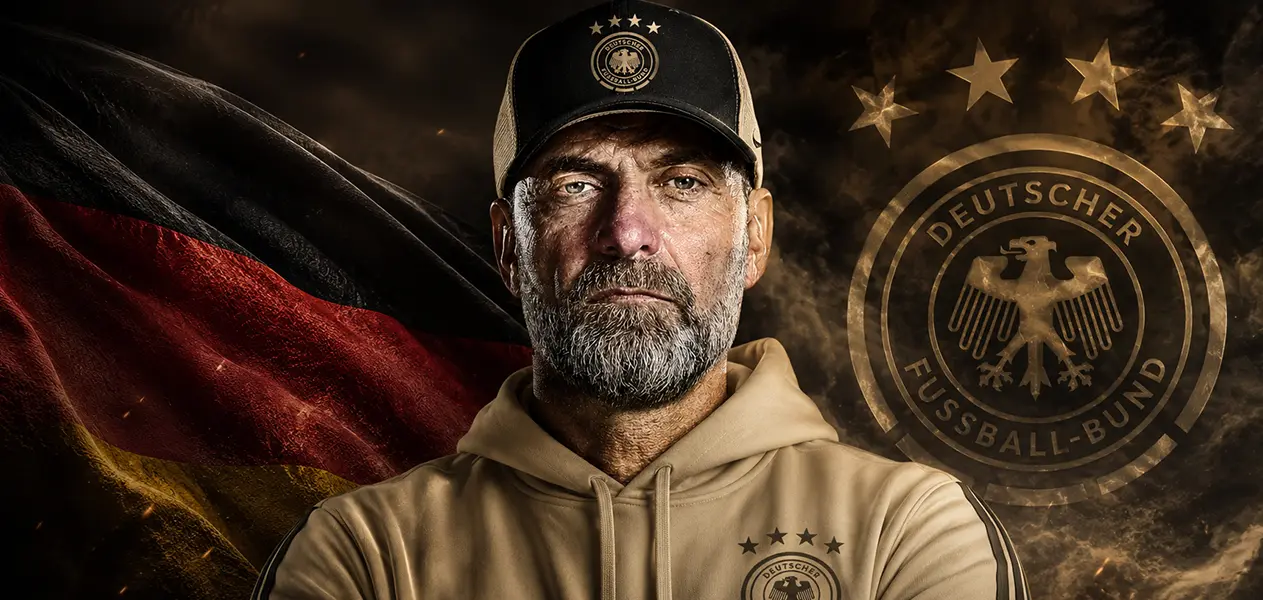
Former Liverpool and Borussia Dortmund manager Jürgen Klopp has been unveiled as the new head coach of the Germany men’s national football team. He takes over from Julian Nagelsmann, who left after his side’s disappointing exit from the 2026 FIFA World Cup.
Germany are coming off another underwhelming World Cup campaign, having been stunned by a relatively weaker Paraguay side in the round of 32. Since winning the World Cup in 2014, they have been knocked out of the World Cup in the group stage twice and couldn’t get past the first knockout round this time around. For a country with a rich footballing history and no dearth of elite talent, Die Mannschaft have underperformed for more than a decade now.
After Nagelsmann’s departure, there were already a lot of rumours and speculation surrounding Klopp, who was being considered the prime candidate. So it was hardly a surprise when he was appointed. Players and fans were overjoyed with the news, but the big question now arises: can Klopp revive the German national team and possibly sign off a highly successful coaching career with international silverware?
Klopp has an impressive resumé of coaching success along with an incredibly positive mindset. He has the ability to rebuild teams from the ground up, develop promising talents into world-class players, and win silverware while playing the most attractive brand of football. He overachieved with Mainz before breaking Bayern Munich’s dominance in the Bundesliga by leading Borussia Dortmund to two league titles. He then challenged Pep Guardiola’s Manchester City juggernaut, winning Liverpool their long-awaited league title after three decades of obscurity.
He doesn’t have any experience with a national team, but club football is far more challenging and stressful in terms of schedule and overall competition. Klopp left after nearly nine years in charge in 2024, feeling that he was no longer able to cope with the constant pressure and scrutiny of coaching at the top level. Hence, I feel coaching the German national team is something he will relish, as it will be less taxing, although expectations of him will still be extremely high.
Under the previous two managers, Hansi Flick and Julian Nagelsmann, there was a growing feeling that Germany were unable to produce the kind of attacking football traditionally associated with them. Although they scored seven goals in their opening World Cup match against an inexperienced Curaçao side, they struggled to consistently create clear-cut scoring opportunities. Another major concern was the absence of a world-class striker. Nick Woltemade and Kai Havertz are decent options up front, but neither possesses the clinical finishing of players like Harry Kane or Erling Haaland.
We are all aware of Klopp’s qualities as a coach. He isn’t just a top tactician, but also a man with great presence and exceptional communication and man-management skills. He brings warmth and trust while expressing belief in his players, while he also has a track record of developing great talents into world-class players: Robert Lewandowski, Mats Hummels, and Mario Götze at Dortmund, and Sadio Mané, Mohamed Salah, Trent Alexander-Arnold, and Virgil van Dijk at Liverpool are but a few examples of this.
Klopp is a very positive person, but he also has a very reasonable head on his shoulders. He will be enthusiastic about the Germany project, but he also knows there will be challenges and roadblocks to building a winning culture. He’ll first need to identify the kind of players who will suit his style of play, and he isn’t the kind of coach who believes in fostering a superstar culture. Hence, all players, regardless of stature, will have to prove themselves with consistent performances and give 100% in training to even be in contention for the national team.
Undoubtedly, Klopp has a massive challenge in front of him, and he knows a project like this needs time and patience. However, he has done this twice before, at Dortmund and Liverpool, and knows what it takes. There are issues with the style of play that need to be dealt with. The slow build-up play and a clear lack of speed in the team need to be addressed; knowing Klopp, he could turn this team into an attacking and effective high-pressing unit.
Since he is also known for developing young talent, he can build the team with the likes of Jamal Musiala, Florian Wirtz, Karl Lennart, Aleksander Pavlovi?, and Tom Bischof, while also including the experienced Joshua Kimmich, Deniz Undav, Jonathan Tah, and Nico Schlotterbeck. Klopp also needs to identify a top striker and a reliable goalkeeper after the retirement of Manuel Neuer.
Klopp has plenty to assess and several issues to address before Germany take on the Netherlands in the UEFA Nations League during the September international break. While it would be unrealistic to expect immediate success, Die Mannschaft supporters will be looking for the initial signs of progress, particularly the emergence of a clear identity and more creativity.
The task is far from straightforward, but Jürgen Klopp’s world-class coaching pedigree makes him the ideal choice to lead this rebuilding process. Few managers can inspire a team, galvanise the supporters, and instil the passion and belief that Klopp has consistently brought to his teams in the past.
Having seen it at Dortmund and Liverpool, there is every reason to believe that, by the end of Klopp’s tenure, Germany will once again be counted among the world’s elite international football teams, competing consistently for the sport’s biggest honours.