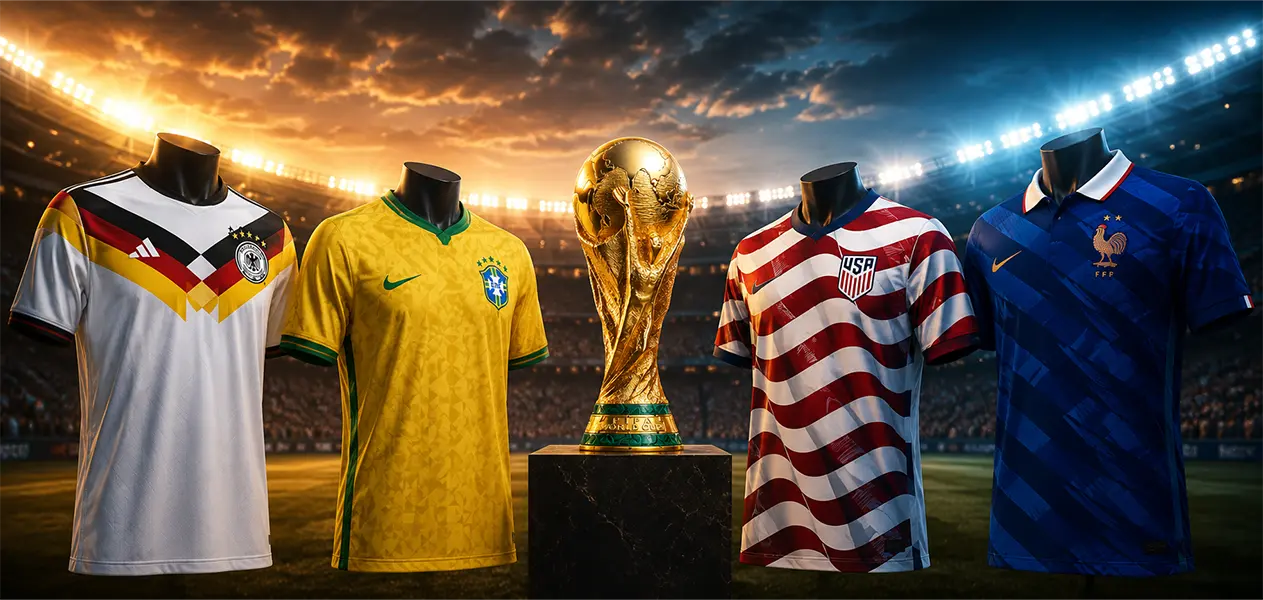
FIFA World Cup 2026: All about national team kits and how they compare to club football

Premier international football tournaments such as the FIFA World Cup, the UEFA European Championships, the CONMEBOL Copa América, the AFC Asian Cup, and CAF’s Africa Cup of Nations are massively followed events.
While most of the above-mentioned competitions are usually limited to one continent, the World Cup, as the name suggests, is contested by teams representing nations from all over the world.
National team kits are different from their club-football counterparts not just in terms of colours and patterns but are also aesthetically cleaner on account of not having to sport much of the sponsorship detailing that has become commonplace in club football due to FIFA regulations.
Here, let’s take a look at the national team kit rules and regulations ahead of the 2026 FIFA World Cup and see how they differ from the ones governing club football.
National teams at the FIFA World Cup
The national team jerseys of teams participating in the World Cup need to be designed in accordance with the FIFA Equipment Regulations.
According to FIFA, national team jerseys should only feature the crest of the country’s football association, the kit manufacturer’s name, and player numbers and names on the shirt. No sponsor logo should be present on any part of the matchday kit, though players can feature sponsors on their pre-match and training kits.
Before the tournament, each team is required to notify FIFA of its preference for a minimum of two contrasting colours (one predominantly light and the other dark) for its first-choice and alternative kits (shirts, shorts, and socks), with three different colours for the goalkeeper kits.
The player numbers should only be selected from 1 to 26, with 1 being exclusive to the goalkeepers. In case the keeper needs a replacement, that keeper takes the next available number (27). According to the FIFA Equipment Regulations, numbers need to be displayed at chest height on the front of the shirt as well as on the front of the shorts, apart from being on the back of the shirts.
As for names, they shall be placed above the number on the back of the shirt and should be clearly legible according to the regulations. In case of two or more players having the same name on the back of the shirt, further letters or initials are to be added to make a clear distinction.
Each team also needs to provide a set of goalkeeper shirts without names or numbers. These shirts are only used for special circumstances, in which an outfield player may have to slot in between the sticks during a match. This extra set of goalkeeper shirts should be provided in the same three colours as the regular goalkeeper shirts.
In addition, the display of political, religious, or personal messages of any nature in any language or form by players and team officials on their playing or training kits or other clothing (outerwear and formal attire) at any time before or after the match is strictly prohibited, including accessories like kit bags, beverage containers, and medical bags. Similar displays of commercial messages and slogans of any nature in any language or form by players and officials are not allowed at any official activity organised by FIFA, including official matches and training sessions, as well as during official press conferences and mixed-zone activities.
Club football
In contrast to the national team regulations, club football works very differently. Clubs rely massively on sponsorship revenue to manage their heavy finances, and therefore, barring a few exceptions, there aren’t many strict rules prohibiting sponsorships.
Top European clubs like Real Madrid and Manchester City have forged expansive partnerships with brands like Adidas and PUMA for multi-million kit-manufacturing deals on long-term contracts, while also having massive sponsorship deals for spots on their jerseys.
Depending on different governing bodies and competition levels, the rules for team kits vary for different domestic leagues and related tournaments. However, to avoid clutter and irregularities, many governing bodies have uniform rules regarding placement of sponsors, names, and numbers, while prohibiting or limiting display of sponsorship from certain categories (like tobacco, gambling and betting, and alcohol). Similar to the FIFA regulations, there are strict rules regarding sponsor logos displaying political, religious, or offensive messages on club jerseys.
According to most governing bodies for club football, a matchday jersey can sport logos on the front of the shirt and on one of the sleeves, with some even allowing placement on shorts and on the back of the shirt, with logos of the kit manufacturers usually placed on the left-chest side, as is also often the case with national team kits.
FIFA Club World Cup
The FIFA Club World Cup involves clubs from around the world and was restructured last year into a quadrennial event, adopting a similar format to the FIFA World Cup, with 2025 featuring its inaugural edition. The annual club-football tournament previously called the FIFA Club World Cup has since been renamed the FIFA Intercontinental Cup.
FIFA’s regulations for shirt sponsorship for the 2025 Club World Cup were slightly different from those of the 2026 FIFA World Cup. Clubs were only allowed to keep the existing main sponsor on the front of the shirt, but sleeve sponsors were strictly prohibited. Each club needed to provide at least two contrasting kit colours for first-choice and alternative team kits and three contrasting colours for the goalkeeper kits, which would be different from the outfield kits. As for player names and numbers, both needed to appear on the back of the shirt in a legible manner as per FIFA regulations, with the number also appearing on the player’s shorts.
If a certain FIFA competition requires the player number to feature on the front as well, then it should correspond with the names and numbers on the official submitted players list. The kit manufacturer’s name should feature on the front of the shirt (either on the left chest or the middle), on the sleeve, and on the shorts as well. The tournament badge should feature on the sleeve of the jersey. The team who won the most recent edition of the Club World Cup (Chelsea, at the moment) are also allowed to display the “FIFA World Champions” badge in all competitions they participate in until the next edition. For the 2025 edition, FIFA even allowed clubs to create special tournament-themed or special-edition kits to wear in the competition in accordance with its Equipment Regulations.
Again, there’s a prohibition on displaying any religious, political, personal, or offensive message, slogan, or logo on the kits and equipment for clubs participating in the FIFA Club World Cup.
Conclusion
Club kits feature more sponsor details as they focus more on the financial aspect. On the other hand, FIFA tournaments featuring national teams do not feature many sponsors on the kits, as they offer exclusivity to their sponsors and therefore avoid displaying sponsors on the team kits to ensure the promised exclusivity.
While there are key differences between national team kits and their club football counterparts, there are some notable similarities as well.
Some common features include the placement of the player name and numbers at the back of a shirt. Another regulation that remains uniform is the prohibition of any religious, political, personal, or offensive messaging on the kits and equipment to ensure no particular group, religion, or person is offended, thereby promoting inclusivity and maintaining harmony.