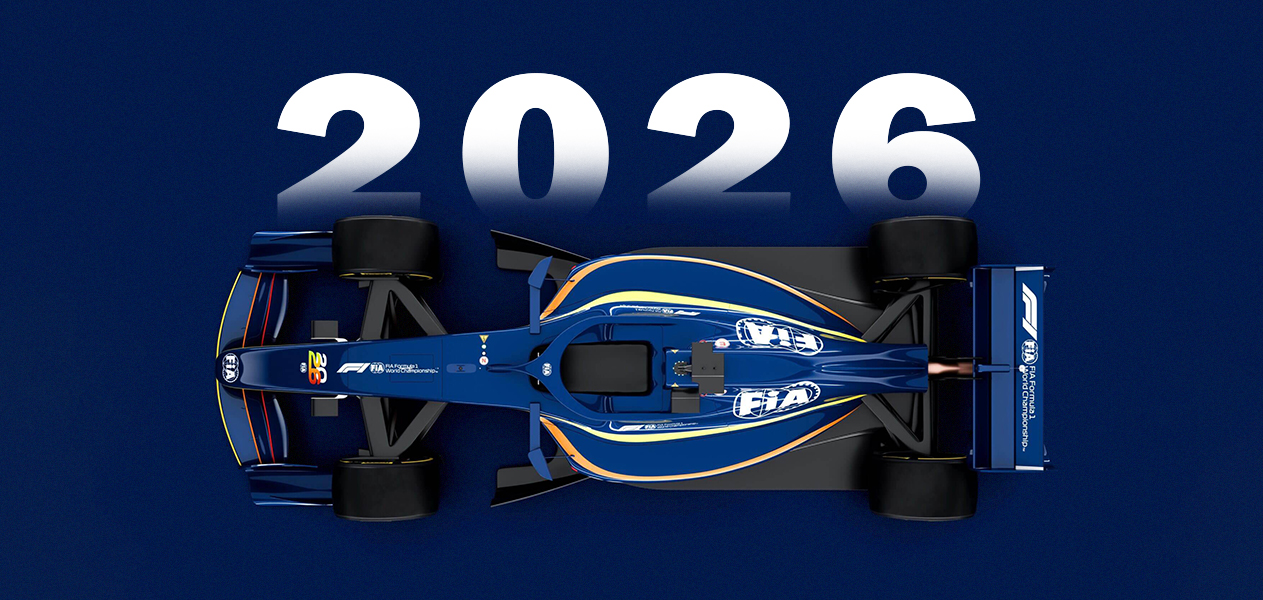
F1 2026: 7 technological innovations set to change the game

The 2026 Formula One season is bringing with it a uniquely large set of regulation changes, as the sport is introducing a new chassis and power unit at the same time.
Alongside that, we have a new team joining the grid in Cadillac, new power unit manufacturers in Audi and Red Bull Ford Powertrains, and the cars looking (and potentially sounding) different.
With all that in mind, here we take a look at seven technological innovations set to change F1 next year.
1. Smaller Cars
The FIA has aimed to make the cars more nimble in 2026, with the machine having continuously grown over the decades.
While still large, here is a look at how the cars match up in terms of size, with the wheelbase and width brought down in size by 5.5% and 5%, respectively.
| Cars | F1 2025 | F1 2026 |
| Length | 3600mm | 3400mm |
| Width | 2000mm | 1900mm |
2. Lighter Cars
The cars next year will be much lighter than their 2025 predecessors, as part of the FIA’s “nimble car” mission.
The minimum weight of the cars, including tyres and drivers, will be dropping by 4% overall, or 32kg from their minimum weight of 800kg, with 768kg being the new minimum from next year.
3. 50/50 Engine Split
The way power is generated will be changing significantly, but predictions suggest the amount of horsepower should remain largely the same, at just over 1000bhp.
A much bigger focus is being placed on electric power deployment, with around treble the power coming from the MGU-K compared to 2025, alongside a move to fully sustainable fuel from the repurposed internal combustion engine, which will see its power output reduced as the electrical element increases.
This, in turn, will allow a targeted drop to around 70kg of fuel use per race, down from the 100kg used in 2025.
The F1 2026 figures below are projections for now, with the manufacturers in an arms race to produce the very best power unit possible when the season gets underway, meaning each manufacturer may differ slightly in its power output.
F1 2026 projected power unit specification
Engine: 1.6-litre V6 turbo hybrid
Fuel: Petrol direct injection from 100% sustainable fuel
Internal combustion engine power: Approx. 535bhp [400kW]
MGU-K power: Approx. 470bhp [350kW]
Total power: Approx. 1000+bhp
Fuel use limit: Approx. 70kg per race
Maximum ICE revs: Unlimited since 2022
F1 2025 power unit specification
Engine: 1.6-litre V6 turbo hybrid
Fuel: Petrol direct injection, at least 10% sustainable advanced ethanol
Internal combustion engine power [combined with MGU-H]: Approximately 850bhp [630kW]
MGU-K power: 160bhp [120kW]
Total power: Approx. 1000+bhp
Fuel use limit: 100kg per race
Maximum ICE revs: Unlimited since 2022, though teams typically rev to 12,000rpm
4. Slower Cars
It is believed that the F1 2026 cars are likely to be slower over one lap than in F1 2025, though it is difficult to say by how much.
While nothing has been publicly released that could help predict the pace difference between F1 2026 and F1 2025 cars, teams can always be relied upon to improve their speed as seasons progress.
The cars in F1 2025 are among the fastest the sport has ever seen, and with less downforce and less drag projected in 2026, improved straight-line speed is set to be coupled with lower cornering speeds, with lap times likely to be slower than in 2025 as a result, at least to begin with.
5. Active Aerodynamics
The drag reduction system (DRS) has long been used as an overtaking aid. However, the movable rear wing is being replaced next year with a movable rear and front wing system in order to reduce drag even further.
This new system will not be an outright overtaking aid, because unlike DRS every driver will be able to make use of it, rather than one car chasing another.
The new way of driving will enable drivers to switch between Z-mode, the standard driving setting with the front and rear wings closed, and X-mode, with both front and rear wings open, at multiple points on the lap when safe to do so.
Like DRS, the use of X-mode zones has reportedly been discussed, but exact details are yet to be finalised at the time of writing. The FIA say X-mode will be driver-controlled and could be switched off by the driver or, as is the case with DRS, turned off automatically by applying the brake.
6. Smaller Tyres
The 18-inch wheels introduced in 2022 are staying on, but the tyres are reducing in size slightly, with F1 tyre supplier Pirelli shaving 25mm in width off the front tyres and 30mm off the rear ones.
This is predicted to save 5kg across a full set of four tyres, with Pirelli also projecting a minimal loss of grip at the same time.
7. Safer Cars
The FIA is always looking to make the race cars safer, and the 2026 editions will be no exception.
Despite the cars being made lighter overall, there are increased protections around the front impact structure, a doubling of protection around the fuel cell, a roll hoop load increase from 16G to 20G, with lateral safety lights set to be fitted to show the ERS safety status on a car, adding a further layer of protection to both drivers and marshals while out on track.