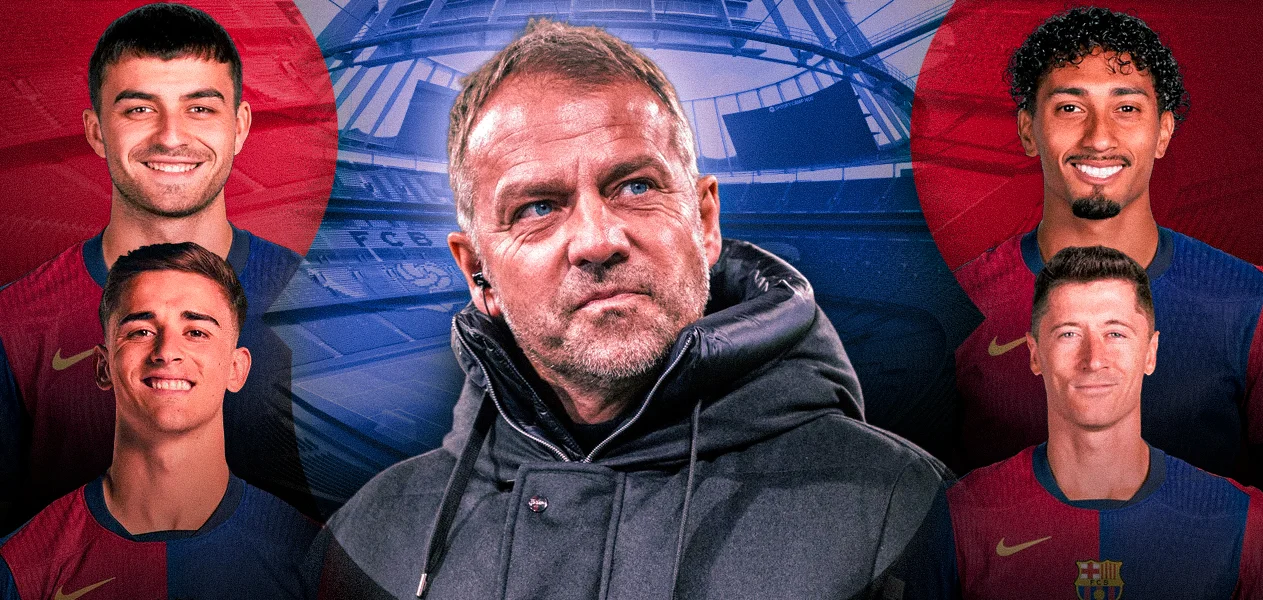
The rise of FC Barcelona under Hansi Flick

Less than a year after suffering the humiliation of becoming the first head coach of the Germany men’s national football team to be sacked, Hansi Flick has restored his reputation at FC Barcelona by turning their fractured men’s squad into one of Europe’s most exciting teams.
Here, we look at where Barça and Flick were when they joined forces, and how far they have come in their short time together.
A marriage waiting to happen?
When Ronald Koeman was sacked in October during the 2021/22 season, Barça president Joan Laporta approached Flick first, but the 60-year-old had already given the nod for the Germany job and respectfully declined Laporta’s approach.
However, Germany’s disastrous World Cup campaign in Qatar massively hit Flick’s reputation—a coach who had previously enjoyed immense success at club level with FC Bayern Munich. His squad selection drew criticism, and his once-successful pressing game didn’t translate well to the international stage.
Flick was fired after a loss at home to Japan in September 2023. For a coach who once secured a sextuple with Bayern, it was a dramatic fall.
During this time, Barça weren’t exactly lighting up the pitch in either LaLiga or Europe before the German’s arrival. The Catalan side had gone trophyless in two of their last three seasons, only winning LaLiga in between—in 2022/23.
While club legend Xavi Hernández honoured the Barcelona philosophy, there were far too many structural defects in his system that resulted in two UEFA Champions League group stage eliminations as well as frequent defeats at the hands of teams much smaller than them in stature—those predominantly using low blocks. Thus, it was only fair for Joan Laporta to come calling for the man he wanted in the first place.
Out of work and with a tainted reputation, Flick came on board the fractured Barça ship. Within a season, he has showcased his managerial expertise with the Blaugrana, who are now on the brink of completing a historic treble this season.
How has Flick changed Barça?
Flick’s Barça press higher and harder than they did under Xavi, replicating his style of play from his time at Bayern. In his system, players have clear roles and play faster, simpler football without losing individual flair. He has successfully managed to merge Barça’s traditional strengths—technical midfield play—with German football principles—pace, verticality, and physical dominance.
This has overwhelmed many opponents, as the high-pressing, quick-transition approach complements the club’s DNA while adding some much-needed intensity.
Flick’s 4-2-3-1 system allows fluid transitions between attack and defence, optimising both the creative and defensive facets of the game. The biggest evidence of this change is Barça’s usual midfield under Flick. By pairing Frenkie de Jong with Gavi and Pedri in a double pivot, he has ensured defensive stability without compromising creativity.
His Bayern roots are also evident in Barca’s pressing structure. The players regain possession high up the pitch, unsettling opponents and creating quick scoring opportunities.
A tactical overhaul
Barcelona’s system under Flick is starkly different from their traditional 4-3-3, particularly in terms of positional play and defensive structure.
Flick’s 4-2-3-1 system deploys a double pivot in midfield to provide defensive stability and transitional support. This enables the team to control counters more effectively than with the traditional 4-3-3, which features a lone No. 6.
This system is also more direct, focusing on breaking lines quickly through vertical passes, thus differing from Barça’s previous slower, possession-based build-up. Moreover, Flick often deploys an aggressive, coordinated press that forces errors in advanced areas, leading to high turnovers.
Flick’s 4-2-3-1 provides greater defensive security and quick transitional play, whereas Barcelona’s traditional 4-3-3 is more suited for controlling possession and exploiting spaces but struggles against compact, low-block defences.
That said, at times Flick’s 4-2-3-1 can also become predictable when over-reliant on verticality.
Maximising player potential
Hansi Flick’s standout attribute as a coach is his knack for maximising the potential of individual players, which has been pivotal to Barça’s resurgence under him.
Under his guidance, Robert Lewandowski, despite being in the twilight of his career, has rediscovered his best form. Flick’s system is tailored to leverage the veteran Pole’s strengths as a target man and clinical poacher, allowing him to lead the attack with efficiency and confidence. Moreover, given his age, the robust high pressing and verticality allows the 36-year-old to stay much closer to the opposition box.
Marc Casadó is a player who best represents Flick’s hybrid philosophy. Another gem from La Masia, the 21-year-old midfielder epitomises Flick’s vertical tiki-taka approach with his technical prowess and ability to progress play by breaking lines, while also providing a shield for his defence with his physicality.
That said, perhaps no player has benefited more from Flick’s arrival at Barça than Raphinha. The Brazilian winger admitted that he did not initially respond well to conversations with Flick regarding his role, but his acceptance towards flexibility saw him named one of the captains of the team and become one of the most in-form and impactful players this season.
Similarly, the midfielders have also flourished under Flick’s nurturing approach—in particular Gavi and Pedri. Gavi’s tenacity and aggression perfectly complement Pedri’s composure and finesse, creating a dynamic and balanced partnership that has become the engine of Barça’s success.
Flick’s ability to identify and optimise each player’s role within his tactical framework has not only elevated individual performances but also created a cohesive and formidable team environment.
What can Flick’s Barça achieve?
Just one year into the job, Flick has Barcelona on the verge of a treble. The Catalan giants have already secured the Copa del Rey and the Supercopa de España, are leading LaLiga by four points with four matches to go, and are in the semi-finals of the Champions League. Their last treble came in the 2014/15 season under Luis Enrique.
Flick knows what it takes to win a treble, having done it in 2020 with Bayern Munich. It is worth remembering for narrative’s sake that his Bayern side famously demolished Barcelona 8–2 in the UCL quarter-finals that year.
Barcelona drew the first leg of their UCL semi-final tie against Inter Milan 3-3 at home and now have to produce a solid performance away at San Siro to book their place in the final. With four games remaining in LaLiga, they next face second-placed Real Madrid at home—a match that will almost certainly decide the fate of the title race.
In a profession that rarely offers coaches a second chance at the highest level, Hansi Flick has already achieved more than many expected after he was removed from the Germany job. Now, he’s just a couple of steps away from one of the greatest coaching comebacks of the modern era.