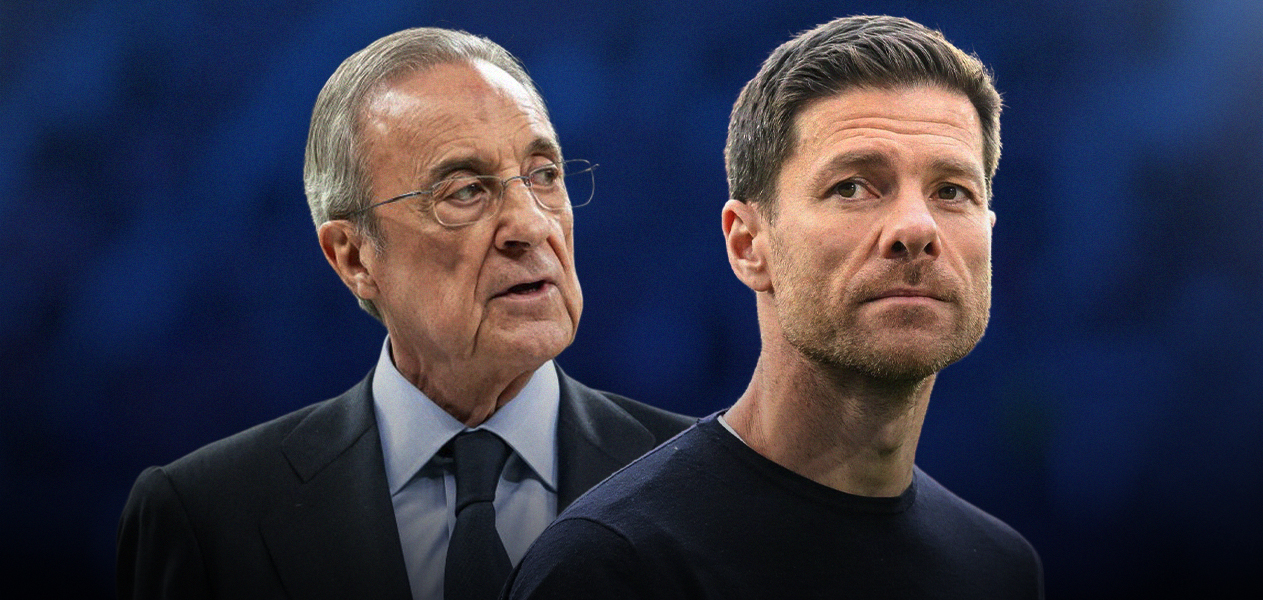
Xabi Alonso under fire at Real Madrid: Has the midfield maestro been a managerial misfire?

One of the best in his position during his playing days, Xabi Alonso spent five successful years at Real Madrid (2009–14), winning the coveted Champions League and LaLiga titles among other accolades. The Spanish midfield general was an instant hit with the Bernabéu faithful, becoming an icon at the club despite his short tenure.
Thus, it was almost poetic when Alonso returned to the club to rescue them from slumping further in their pursuit of European domination. Surely, someone who had the pedigree to turn a relegation-battling Bayer Leverkusen side into Bundesliga champions within two seasons could perform incredible feats with Europe’s most successful side?
However, halfway through his first season at Real Madrid, there are hordes of Madridistas and local newspapers calling for Alonso’s head as the team continue to underperform during this busy December–January period. Here, we look at what has transpired thus far, and whether Alonso will survive the ongoing storm.
The honeymoon period
The big announcement in May earlier this year felt like the dawn of a new identity. With Carlo Ancelotti’s second era drawing to a close, Florentino Pérez secured the one man who was being sought by every elite club. Xabi Alonso arrived at the Bernabéu with the “invincible” tag still fresh from his time at Leverkusen, and for the first ten weeks of the 2025/26 campaign, it seemed the hype was well and truly justified.
His Real Madrid side hit the ground running, winning 13 of their first 14 matches across all competitions. They weren’t just mere wins, and you could see a visible shift in the way the team played both in and out of possession. Fans at the Bernabéu, long accustomed to Ancelotti’s passive individual brilliance–based system, were treated to a rigorous, high-possession structural masterclass.
Moreover, integrating new summer signings Trent Alexander-Arnold and wonderkid centre-back Dean Huijsen laid the foundation for a new-look, press-resistant defence. By late October, Real Madrid sat five points clear at the top of LaLiga and had a 100% record in the Champions League, having won all three games. Alonso, the golden boy and master tactician, was making the transition look too easy.
Injuries exposing frailties in the system
Xabi Alonso’s success at Leverkusen relied heavily on a system that deployed high-functioning wingbacks — Alejandro Grimaldo on the left and Jeremie Frimpong on the right — to provide width and verticality. At Real Madrid, he designed a similar blueprint around Dani Carvajal and Trent Alexander-Arnold.
However, in a twist of fate, Alonso lost five key defensive personnel within a month. Carvajal suffered a knee injury in late October that ruled him out at least until February, while Alexander-Arnold suffered a muscular tear in the first week of December. Both David Alaba and Ferland Mendy are also ruled out with muscle injuries, while Brazilian centre-back Éder Militão will only be available in April following his own muscular tear.
Without players of the specialised profiles required for his complex positional play, Alonso has been forced to move Federico Valverde into the backline and rely on the inexperienced Raúl Asencio to shore up any defensive frailties. However, the end product has been a loss of control. There is an evident gap in communication between the lines while defending out of possession, and opposition teams are finding it easy to pick apart the Real Madrid mid-block centrally.
As a result, a string of four wins, three draws, and three defeats in ten games across all competitions has seen Los Blancos drop four points below Hansi Flick’s resurgent Barcelona in LaLiga, while in the Champions League they’re currently seventh in the league phase table with 12 points.
The dressing-room divide and the pressure of managing superstar egos
At Leverkusen, Xabi Alonso was the undisputed star, a legendary former footballer leading a group of hungry, talented players to go up against the rest of Europe. In the Real Madrid locker room, the dynamic is quite different. Managing a €1.38bn squad featuring some of the biggest global superstars of the game requires more than just tactics; it requires exceptional man-management skills and political navigation.
Despite struggling to string together a run of solid performances, a faction of players have shown fight and come out to speak in support of Alonso, especially following their loss to Manchester City at home in the Champions League. The likes of Raúl Asencio, Jude Bellingham, and Rodrygo (who even shared a warm hug with Alonso during the game) have all shown support to the 44-year-old.
However, the cracks are also there for all to see. The most glaring issue is the slump in form of Vinícius Júnior and the consequent sharp decline in his attitude. The 25-year-old has gone 17 matches without a goal for club and country. Reportedly unhappy about his role and the manner in which he has been treated, Vinícius has been framed by the Spanish media for a broader dressing-room split since the breakdown of his relationship with Alonso.
The conflict began in the summer, during the Club World Cup semi-finals, where Alonso initially planned to bench Vinícius and later deployed him on the right wing, a position the Brazilian strongly dislikes. Since then, the player has viewed the reduced minutes and repeated rotations as a loss of trust, which has further fuelled his frustration and shaped his stance toward the coach.
The situation further intensified after Vinícius reacted angrily to being substituted in El Clásico in October, a moment that demanded a public apology from the player. While he apologised to his teammates and the club as a whole, he notably did not mention Alonso, which many interpreted as a deliberate omission.
Last month, reports suggested that the Brazilian had stalled talks and informed club president Florentino Pérez that he would not commit to a long-term contract as long as the ongoing coaching situation remained unresolved. While the club hierarchy has continued to publicly declare its support for Alonso, Real Madrid’s history shows that results, dressing-room unity, and player power ultimately determine managerial longevity.
With Vinícius positioned as a cornerstone of the club’s future project, the tension places extraordinary pressure on Alonso to regain control before long-term fractures set in.
Final verdict
This is the question hanging over the Bernabéu as Real Madrid get ready to host Sevilla: is Xabi Alonso out of his depth in the most volatile dugout in the world, or is he just a victim of circumstances?
Only six months into his three-year contract, the Spaniard still boasts a win percentage of over 70% despite missing four of his five starting defenders. Even in their 1–2 loss at home to Man City, the underlying metrics showed a team who outplayed the English giants for most of the game.
To fire a proven winner during an injury crisis would be seen by many as short-sighted, even by Madrid’s standards. That said, Florentino Pérez and Real Madrid don’t really do transition years, especially right after a season where they failed to secure major silverware. The Real Madrid hierarchy is known for being notoriously impatient when it comes to pulling the gun on managers, and with the Opta supercomputer now giving Barcelona a 71.42% chance of winning LaLiga, the fear of another season like the last one is palpable.
Following the Man City defeat, many Spanish outlets reported that the next three games would decide Xabi Alonso’s fate. Despite unconvincing performances, the Spaniard has managed to win all three, which might just have bought him a peaceful Christmas.
A significant portion of the squad still backs him. Moreover, a recent poll conducted by Marca with over 120,000 Real Madrid supporters suggested that 61% of the fan base believes the problem lies on the players’ end, with 76% supporting Alonso’s work thus far and 86% believing that the situation with Vinícius is unrepairable and he should thus be sold.
With all these factors in play, it would be premature to sack Alonso after just six months, even by Real Madrid’s own lofty standards. Besides, there are no guarantees another manager can instantly improve the performances and morale of the squad, given there are so many enigmatic characters in the dressing room.
Therefore, Real Madrid ought to stick with Xabi Alonso at least till the end of the season and see how he manages to turn things around in the second half of this campaign with a fully fit squad before jumping the gun.