Is Europe getting weaker, or has the Premier League become stronger?

The league phase of this season’s UEFA Champions League has drawn to a close. It was a night of unparalleled drama in the Champions League: 61 goals scored across 18 matches, qualification scenarios shifting by the minute, and fates being rewritten with every passing second.
Teams like Benfica and Bodø/Glimt beat the odds and registered huge upsets to get into the play-off round. However, it’s only when you look at the other end of the table that UEFA’s real dilemma becomes clear.
It was a night that drew more criticism than appraisal, as five out of the six Premier League teams advanced directly into the Round of 16. For a governing body that introduced this new format seemingly to put the ghosts of the European Super League to rest, five clubs from one league dominating the league phase should ring alarm bells at their headquarters.
Highlights from the league phase of UEFA Champions League 2025/26
Across the league phase, the six Premier League teams played a total of 48 matches, losing only nine and winning 33 combined. They scored 109 goals while conceding just 45, collectively delivering a performance of crushing dominance.
A look at some of the standout results lays bare their superiority. On Matchday 7, Newcastle United thrashed Eredivisie leaders PSV 3–0, despite the Dutch side holding a 14-point lead at the top of their domestic league. Spurs, ranked fourth in the Champions League standings, suffered just one defeat in eight matches, beating LaLiga’s third-placed Villarreal and the Bundesliga’s second-placed Borussia Dortmund. Yet, back in the Premier League, they sit a lowly 14th in the table, with head coach Thomas Frank already facing calls to be sacked.
Similarly, Inter Milan, Serie A leaders and Italy’s strongest team at the moment, were outclassed at home by a rotated Arsenal side, who also defeated Bayern Munich comprehensively at the Emirates, despite the Bavarians being widely regarded as one of the best teams in Europe currently.
Meanwhile, Europe’s traditional heavyweights — Paris Saint-Germain, Real Madrid, Inter, Juventus, and Atlético Madrid — were left to battle it out in the play-offs, with no guarantee of progression.
The evidence is undeniable: Europe’s elites are now struggling to compete with Premier League teams. And the financial imbalance across football will only widen this gap, with this season’s Champions League laying the problem bare for all to see.
A growing trend over the last decade
It is worth remembering that UEFA’s Financial Fair Play regulations were introduced not only to regulate club finances, but also to end the dominance once held by Premier League sides.
From 2004/05 to 2011/12, seven out of the eight UCL finals had at least one English team in them, while the 2007/08 campaign saw the first-ever all-English final in Moscow between Manchester United and Chelsea, with the Red Devils prevailing on penalties. It was against this backdrop that Michel Platini pushed for FFP to be implemented — and it was no coincidence.
For a brief period, it was the Spanish, German, and Italian superpowers that ruled Europe, before Premier League clubs, backed by huge commercial deals and the resultant influx of talent, once again rose from the ashes.
Over the last decade, despite Real Madrid dominating the scene with five Champions League titles, three different English teams have lifted the coveted trophy — Liverpool (2018/19), Chelsea (2020/21), and Manchester City (2023/24) — while there have been two different all-English finals in the last seven years.
Although Arsenal were knocked out in the semi-finals last season by eventual champions PSG, the Europa League saw an all-English affair in the final between Tottenham Hotspur and Man United, while Chelsea lifted the Conference League trophy with a dominant 4–1 win against Real Betis in the final, further highlighting the widening gulf between the Premier League and the rest of Europe.
The gulf in broadcast revenue
Over the last decade, the influx of commercial revenue and the subsequent rise in wage structure have shifted the balance in the Premier League’s favour. As part of the domestic and international TV rights deals, Premier League clubs on average receive £96.9 million in Equal Share payments, while the merit-based payments can take this figure as high as £174 million.
Indeed, looking at the total revenue generated per season, after LaLiga heavyweights Real Madrid and Barcelona, German elite Bayern Munich, and Ligue 1 giants Paris Saint-Germain rounding off the top four spots, the next six spots are all occupied by Premier League clubs.
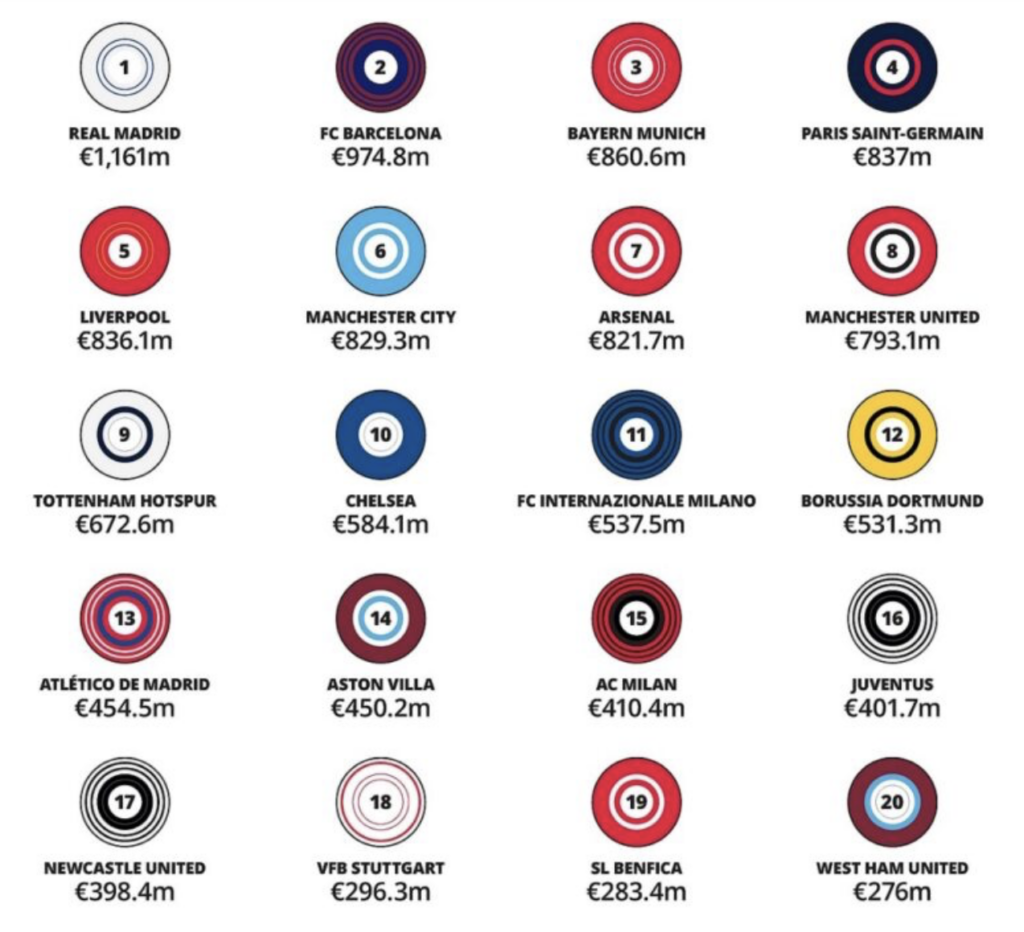
The 2022/23 European treble winners, Manchester City, despite finishing third in the Premier League and getting knocked out in the knockout rounds of the Champions League last season, took home £168.5 million in broadcasting revenue alone.
If we take a look at the figures released by LaLiga for the 2024/25 season, Spanish clubs make far less in terms of broadcasting revenue compared to their Premier League peers. In LaLiga, 50% of the money generated from the sale of television rights is shared equally among the 20 clubs. A further 25% is allocated based on sporting results over the last five seasons, while the remaining 25% is determined by each club’s social and commercial reach.
In that regard, Real Madrid have overtaken Barça as the highest earners from the audiovisual rights for the 2024/25 season, despite the Catalan giants winning the Spanish top-flight title.
Indeed, Real Madrid received €157.52 million from the television rights for 2024/25. Barcelona’s revenue, meanwhile, fell to €156.45 million despite winning LaLiga.
Looking at the Premier League sides, teams that finished outside the top ten, 12th-placed Crystal Palace made £136.1 million in broadcast revenue, while 15th-placed Manchester United made £136.2 million.
Things are more dire when we move to other leagues. The Serie A clubs in general earn way less in broadcasting revenue compared to both LaLiga and the Premier League clubs.
The Italian top flight has a five-year domestic rights agreement in place with Sky and DAZN for the 2024–29 period, which brings the league €900 million per season, while a separate three-year overseas TV rights deal for 2024–27 fetches €367 million annually.
However, after using their revenue distribution methods and using their past standings during the 2024/25 season as reference, the most any Serie A side stands to make during the 2025/26 season is roughly €94 million, in case of Juventus, followed by Inter Milan with €83.2 million and AC Milan €81.6 million, after including both merit-based incentives and the income from the popularity quota.
This disparity in revenue generation has been gradually widening the gap between the Premier League clubs and the rest of Europe, while the latest standings from the league phase of the Champions League shed some light on exactly how big this gap has become.
Wage structures and overall competitiveness
During the 2016/17 season, Spanish giants Real Madrid and Barcelona boasted the biggest wage bills in European football. Barça were leading the way with €260 million in salaries, with Real Madrid sitting some way off in second place with €200 million. Bayern Munich at the time had a wage bill of €162 million, while Juventus, the top side in Serie A during that period, had a wage bill of around €120 million.
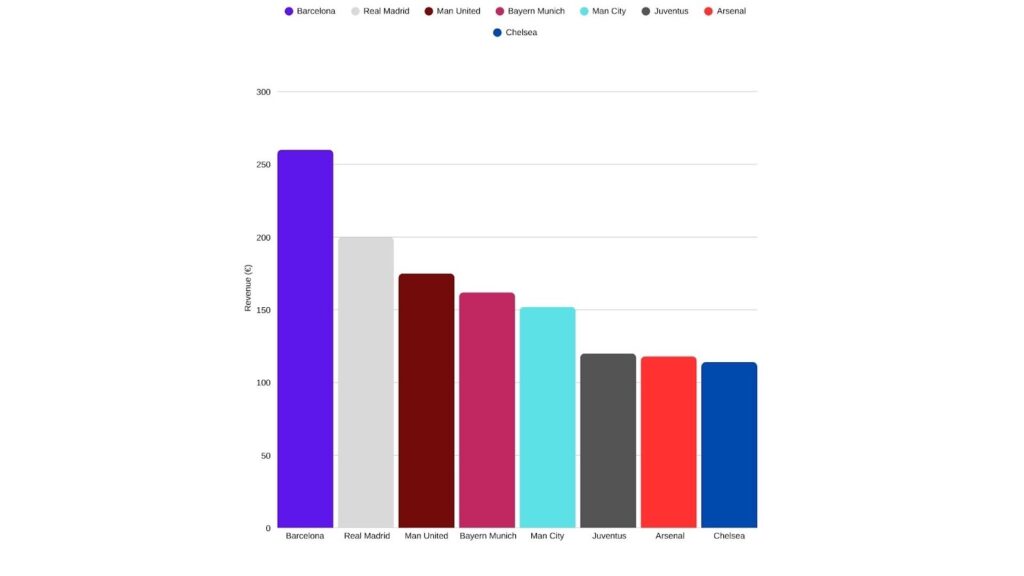
In comparison, Manchester United held the biggest wage bill in the Premier League, rounding off to €175 million, with local rivals Manchester City occupying the second spot with a €152m wage bill. Arsenal, third on the list, had a wage bill of around €118 million.
Fast forward ten seasons, and the entire landscape has changed. Although the highest wage bill in world football still belongs to a Spanish club, it’s Real Madrid who’ve leapfrogged their rivals Barcelona to the top spot. Los Blancos currently have a €307.5m wage bill. Barça, following their recent financial struggles, have seen their wage bill drop to €234 million.
In Germany, Bayern Munich have a wage bill of around €260 million, while Borussia Dortmund (€116 million) are the only other club in Germany to cross the 100-million-euro mark. In Italy, Inter Milan currently lead the way with €135 million, while three other clubs — Juventus, Roma, and Napoli — sit between €110–125 million in wages.
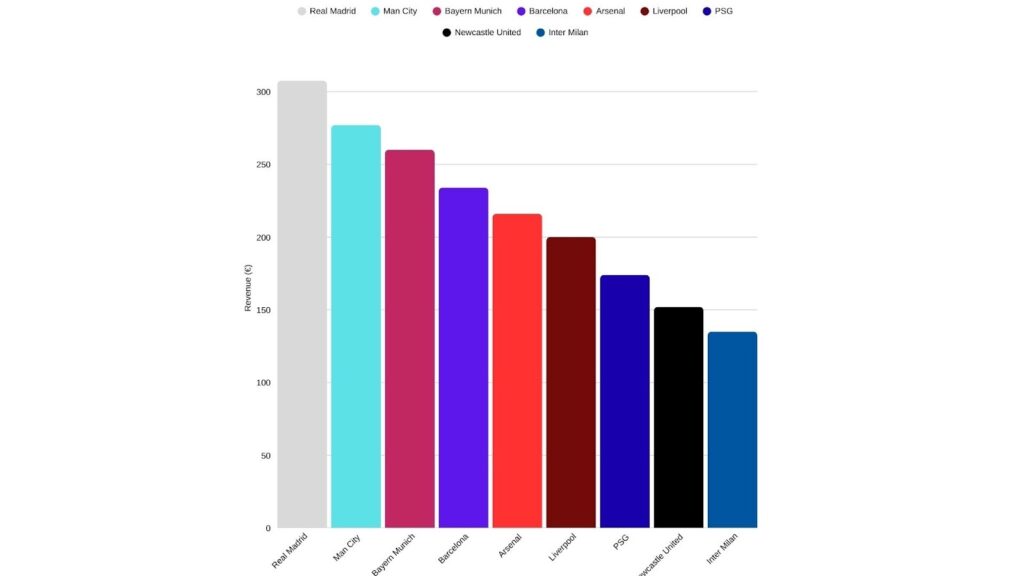
When we look at the English clubs, though, there has been a significant increase in their wage bills. Manchester City lead the way with €277 million in wages, followed by Arsenal at €216 million. However, the most striking aspect of this list is that the club with the eighth highest wage bill in England — Newcastle United with €136 million — are only behind Real Madrid, Barcelona, Atlético Madrid, Bayern Munich, and Paris Saint-Germain across the other four top leagues.
This is the harsh reality of European football. If we dig a little deeper, the wage bill for the top teams in LaLiga has only jumped by 18.2% over the last decade. The top clubs in Serie A have seen a rise of around 40–45%, although both Juventus and AC Milan have done very little in that time. In Ligue 1, PSG have seen their wage bill increase by 45%, though the biggest jump has been seen in the Premier League. Top sides like Man City and Arsenal have seen a 70–80% jump in their wage bills and, as a result, have been able to recruit some of the best talents from around the world.
Why can’t Premier League teams win more UCL titles?
With every piece of data supporting the rise of Premier League clubs across Europe, why do they still struggle to translate their league-phase dominance into knockout success? In the group and league stages, their deep squads and physical intensity allow them to overpower opponents while maintaining high energy levels, dominating continental opposition in near-ruthless fashion, much like Chelsea’s 3–0 demolition of Barcelona in November, which left the Blaugrana shell-shocked.
But come the knockout rounds late in the season, and the tide can turn completely. For one thing, the knockout format is inherently unpredictable, and Premier League sides often face each other as early as the Round of 16 — Chelsea and Newcastle, for instance, could be drawn together prematurely this time around. For another, it echoes a famous line once attributed to Michel Platini, who called English players “lions in winter, lambs in spring,” highlighting that the gruelling domestic English campaigns leave the teams exhausted towards the business end of the season.
Ironically, this physical drain stems directly from the ferocious competition in the Premier League itself. Unlike some of the other top leagues, where it’s a monopoly or duopoly, English teams must battle relentlessly, with one side’s fixture list far more draining than those faced by teams in other leagues.
Bayern Munich, for example, currently hold an eight-point lead at the top of the Bundesliga with just one defeat all season. Given the gulf in quality compared to the rest of the league, they can prioritise the knockout stages when the time comes. The same can be said for Paris Saint-Germain in Ligue 1. Even LaLiga giants Real Madrid and Barcelona have a level of freedom to pick and choose. However, their English counterparts can seldom afford such luxury.
Thus, for now, fixture fatigue appears to be the only hope remaining for Europe’s other clubs to compete with the Premier League. Even that, however, looks like a faint prospect. Premier League clubs keep growing stronger, and the Champions League is increasingly becoming their private fiefdom — in effect, a super league for English sides.