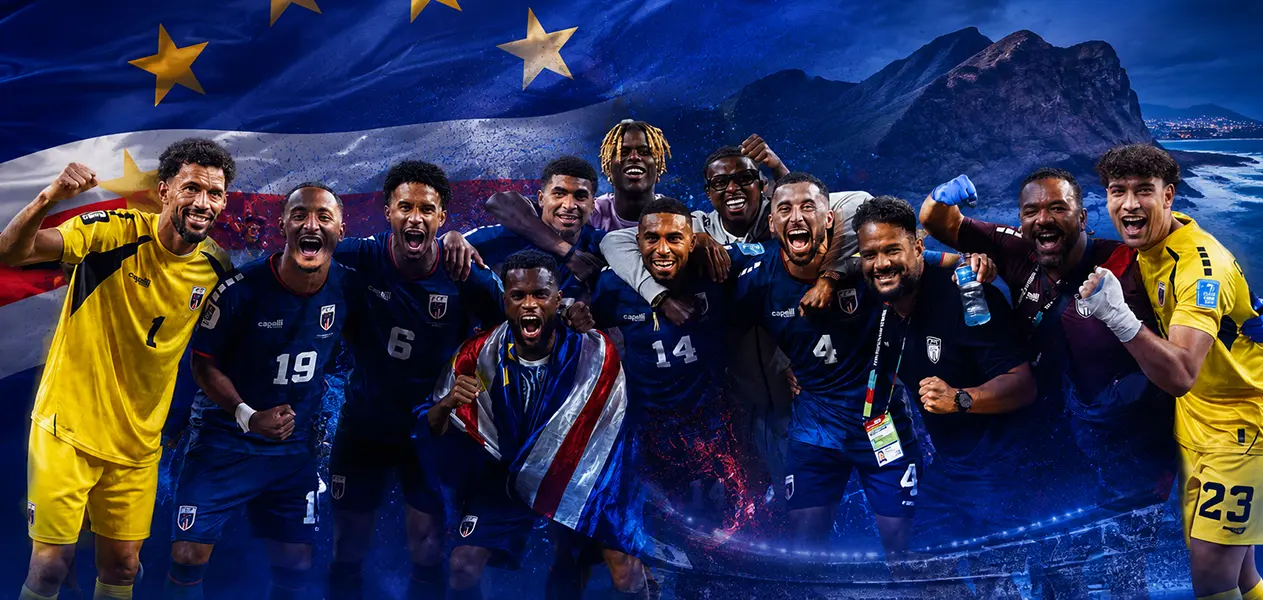
Cabo Verde — small nation, big dreams, a story worth remembering

Imagine being the smallest nation to qualify for the 2026 FIFA World Cup, being completely written off from the start, earning a fighting draw with potential title contenders in the opening game, going on to qualify for the round of 32, and almost scaring the daylights out of the defending champions in the knockouts.
Feels like a dream, doesn’t it? Only it isn’t. Cabo Verde made it happen with their grit, belief, and passion.
On the fourth of July, Cabo Verde played against the defending champions Argentina in the round of 32, a tie that had been dismissed as a cakewalk for La Albiceleste. What unfolded on the football pitch for 120 minutes was entirely different, with the Blue Sharks showing Argentina and the entire world what passion, fight, resilience, and belief can do. They matched the South American giants in every area on the pitch, and even though they lost 3–2 in extra time against a far stronger opponent, they won a million hearts all over the world.
Some of their players, such as goalkeeper Vozinha, fullback Sidny Lopes Cabral, who scored the second equaliser against Argentina with a stunning strike into the top-right corner, and defender Roberto Pico Lopes, have become national heroes and household names all over the world.
The beauty of sport does not lie only in the battle between the big teams with world-class players and managers, but also in the small nations that rise beyond all odds and create some of the most wonderful underdog stories, inspiring not just an entire generation back home to pick up the sport, but also giving hope to other small nations to improve, develop, and dream of becoming the next underdog fairy tale at the biggest sporting spectacle.
For those who are wondering why this is such a big deal, the Republic of Cabo Verde is a small island nation in the Atlantic Ocean, some 600 kilometres west of the coast of Senegal. With a population of approximately 525,000, the country didn’t even have a proper football stadium until 2006 and still has only two football stadiums, thus boasting little in terms of sports infrastructure.
The Cape Verdean Football Federation was formed in 1982 and joined FIFA four years later. The country’s first World Cup qualifying campaign was an attempt to reach the finals in 2002, but the team failed to get past the first qualifying round. Four years later, they reached the third round of qualification for the 2006 World Cup, but yet again they failed to secure qualification, ending fifth in their group.
Their breakthrough tournament proved to be AFCON 2013, where they stunned everyone by reaching the quarter-finals after being placed in a tough group alongside South Africa, Morocco, and Angola. Their next big performance arrived again in AFCON, this time in the 2023 edition, when they defeated Ghana and Mozambique and drew against Egypt to qualify for the knockouts, again reaching the quarter-finals and, slowly and surely, showing the world their definitive steps towards making their World Cup dream a reality.
The defining moment arrived last year, when they secured their first-ever World Cup qualification in October. They topped their CAF qualifying group with 23 points from ten games, a group that also featured African giants Cameroon alongside the experienced side Angola. Their qualification wasn’t built on playing expansive football, but maintaining tactical discipline and efficiency. The Blue Sharks only scored 16 goals in their ten games; three of their seven wins arrived thanks to a solitary goal.
Their World Cup campaign was almost a fairytale run, as they were placed in a highly challenging group alongside Spain, Uruguay, and Saudi Arabia. Yet, the debutants went unbeaten in the group, first by earning a draw against La Roja and then giving Uruguay a massive headache, drawing 2–2 after coming back twice to gain another valuable point, while their final group game ended in another stalemate against the Saudis to secure their passage to the knockouts.
So, the big question is: how did they do it? How did a small nation with next to no grassroots football and sports infrastructure manage to qualify for the World Cup and then challenge the best nations?
Until the 2010s, Cabo Verde hardly got opportunities to play even friendlies, and even when they did, they couldn’t really play at a high level. It was after Portuguese coach João de Deus’ arrival that things started to improve, though the World Cup remained a distant dream. However, de Deus started the process of bringing in Cabo Verde-origin players from foreign leagues to play for the national team.
That pattern is clear in their current squad. 14 of the 26 players who went to the 2026 World Cup live outside the country and play in lower leagues in Europe and Asia. This is the primary reason for Cabo Verde’s two AFCON quarter-final appearances and World Cup qualification.
The improvements can be attributed to astute team selection, exposure to bigger teams and stages, and managerial tactics, but above all, it’s the unity, passion, and unwavering belief that have made Cabo Verde play as a team instead of a group of individuals.
Cabo Verde’s impressive debut campaign also has the potential also unlock significant financial benefits. Strong performances on football’s biggest stage are likely to attract new sponsorship deals for both the national team and the players. With scouts from top clubs watching the event with interest, several squad members could earn transfers to elite leagues. Such is the impact of a standout World Cup performance in modern football, and Cabo Verde are now ready to reap the rewards. This in turn will help them get better and stronger.
These kinds of stories happen only once in a while, but their impact is undeniable for generations. The scenes of their homecoming at Praia International Airport were incredibly emotional, featuring a massive turnout of fans serenading them with love and support. It was a momentous occasion, with the World Cup becoming a huge symbol of national and cultural identity.
Although they ended up losing in the round of 32 in a closely fought encounter, Cabo Verde’s remarkable campaign will remain one of the defining stories of this World Cup. For many football fans, the sport is about more than winning trophies; it’s about courage, passion, belief, and winning hearts, even in defeat. The Blue Sharks embodied that spirit and left the pitch with their heads held high, knowing they had given everything.
Cabo Verde, you will definitely not be forgotten!