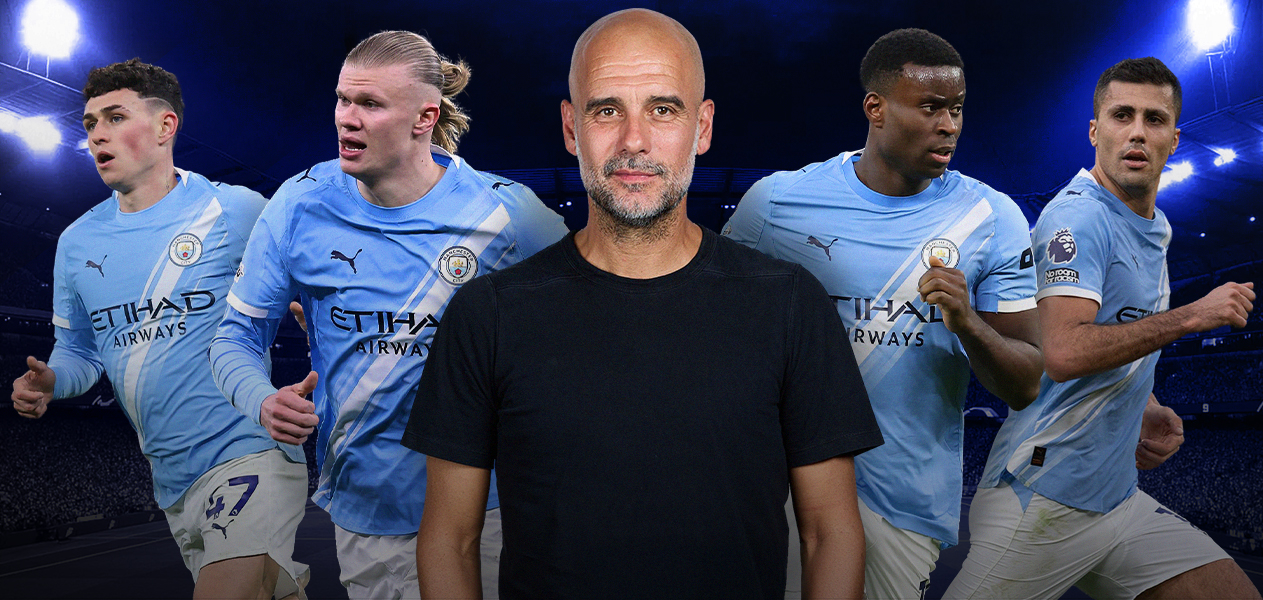
Has Pep Guardiola peaked as Man City manager, or is this just a blip?

The 2024/25 season was below Man City’s usual standards. Weak form, defensive weaknesses, and wasted chances saw them come up short, raising questions about whether Pep Guardiola’s dominance in England was finally coming to an end.
As Liverpool started the 2025/26 campaign as the bookmakers’ favourites, followed by Arsenal, pressure on Guardiola increased, and there were lingering questions asking whether he had peaked at City.
However, the readiness to change, focusing on defensive stasis, tactical domination in midfield, and versatile formations made Guardiola re-establish Man City. The result? A side that is starting to build a new identity and once again challenging for the Premier League crown.
But a new question arises: has the Spaniard done enough? More importantly, with his contract at the Etihad expiring next summer, does he have the will to see this transition through?
From positional play to hybrid systems
When Guardiola first took charge in 2016, his focus was heavily on positional play, with strict adherence to ordered build-up routines and established zones.
City’s style has, however, evolved over the years into a more dynamic hybrid system, one that allows players to change their positions in real time depending on the opposition’s press as well as the state of the game.
In recent seasons, the use of inverted fullbacks, most dramatically so with Rico Lewis, has already made it harder to separate defence from midfield. Guardiola has now extended this thinking, with several players capable of drifting into congested central channels and wingers occupying wide positions to overcommit defences.
The emergence of the box midfield and European glory
One of the characteristic features of City’s recent seasons, and a key part of their 2023/24 title win, was the increasingly dominant box midfield configuration.
By pinning one fullback into the middle to supplement Rodri, and allowing two further midfielders — normally Bernardo Silva and, previously, Kevin De Bruyne — to play between the lines, City gained numerical superiority in the middle third.
This approach not only improved ball retention but also enabled a safe rest-defence structure, facilitating smooth recovery of possession in case of turnovers.
However, during the 2024/25 season, this shape was exploited more often, with opponents hitting them on the break and exposing gaps in transition. Moreover, Manchester City’s defeats to Spurs and Brighton this season have further exposed the fact that this frailty hasn’t been completely dealt with yet.
The Rodri effect
Pep’s tactical evolution through the years has seen multiple shifts, including the revolutionary inverted fullback, the ball-playing goalkeeper, the false nine, the box midfield — the list goes on.
Each of these eras had a big-name hero. Some more than one. All admired for their technical role in shaping Guardiola’s title-winning machine. We’re talking the Fernandinhos, the Vincent Kompanys, the Kevin De Bruynes, and the Sergio Agüeros of this world. The centrepieces.
However, none of them were as integral as Rodri. Few players in world football embody indispensability like him. He is so niche, there perhaps still is no direct replacement for him, and Man City have tended to suffer every time he’s not there, which, since September 2024, has been more often than not.
Manchester City’s drop in form during the 2024/25 season was, if not entirely, largely due to the fact that Rodri suffered a season-ending knee injury. Although Guardiola and his recruitment team brought in Nico González to shore up the defensive midfield duties, he was always a step below Rodri.
Moreover, since coming back from injury, the 29-year-old is yet to get back to his best. There’s no denying his passing mastery, but in defensive transitions he doesn’t seem to have the same recovery pace. As a result, Guardiola has had to take him off regularly in order to protect him for the next fixture. Besides, with him turning 30 next season, Guardiola will have to find a way to make the best use of his abilities.
Same ethos, different philosophy
Manchester City have undergone a clear tactical shift this season, moving away from the wide, methodical positional play that defined their previous dominant sides and towards a more compact, vertical, and flexible system.
However, this transition isn’t just cosmetic; it is rooted in structural adjustments, changes in zonal spacing, and an acceptance that the modern game requires a faster vertical threat, greater efficiency in transitions, and more flexible defensive characteristics than the carefully choreographed positional dominance that defined City between 2017 and 2023.
On paper, Guardiola continues to field his preferred 4-2-3-1 formation, with Gianluigi Donnarumma in goal; Rúben Dias and Joško Gvardiol in central defence; Matheus Nunes and Nico O’Reilly as fullbacks; Rodri and Bernardo Silva in midfield; Phil Foden at No. 10; Antonio Semenyo and Ryan Cherki out wide; and Erling Haaland as the striker.
Yet their functional structure — the way they occupy space, manipulate pressure, and control transitions — has changed far more drastically than the formation suggests.
Compact attacking shape
The defining characteristic of City’s possession game this season has been compactness. Unlike the classical Guardiola shape — a wide player on each touchline, with structured staggering across all five lanes — the current version collapses many players into tight central spaces.
This approach produces several key advantages.
Harder to press
Short passing distances reduce the pressing window created by ball travel time. Since the ball arrives quickly, even correctly timed pressure struggles to reach the receiver before he controls and releases the next pass. Defenders are not only racing towards the ball, but also against an entire cluster of short-passing options that can shift the point of attack instantly.
Faster combinations
Compact spacing enables one- and two-touch combinations that move the ball faster than defenders can adjust their body orientations. These combinations accelerate the speed of attack, making City more unpredictable and more capable of breaking lines without relying on wide, slow circulation.
Rest-defence stability
Compactness gives City immediate counter-pressing superiority when they lose possession. With so many players around the ball, they can swarm, close angles with cover shadows, and shut down counterattacks before they begin.
This addresses one of their biggest weaknesses from last season, where their stretched structure repeatedly left them vulnerable in defensive transitions.
This compact model marks a deliberate shift away from classic width-based positional play and towards a structure built for tempo, protection, and immediate attacking threat.
Final-third play
City now rely heavily on crossing, an intentional adaptation to Haaland’s strong qualities in the penalty area. They deliver from wide zones and from deeper half-spaces, using the fullbacks, inverted wingers, or even midfielders arriving in the channels.
Haaland’s penalty-box movement is elite; he attacks blindside spaces and times his leaps in ways that make him extremely difficult to track, especially when defenders must monitor multiple runners around him.
City also consistently position several players around the edge of the box, which gives them excellent structure for winning second balls, sustaining momentum, and launching repeated waves of attacks without allowing the opponent to reset.
Changes in transition
Attacking transitions
Because City spend more time in mid- and low-block situations and because they encourage opponents to commit more players forward, they now have more opportunities to counterattack than previous Guardiola teams. Their first instinct after winning possession is now vertical: releasing Doku/Semenyo, Cherki, or Haaland early and attacking the empty spaces before the opponent can reorganise.
They commit four or five runners when they counter, which gives them a strong numerical presence against retreating defences and allows them to create chances with far fewer passes.
Defensive transitions
Last season, defensive transitions were arguably City’s biggest structural weakness. Their stretched attacking shape left them exposed after losing the ball, and they conceded too many chances because they could neither counterpress effectively nor delay counters.
This season, their compact attacking structure fundamentally changes that dynamic. With so many players close to the ball, City can counterpress immediately, surround the opponent, and block passing lanes through cover shadows. Their intensity is higher, their timing is more synchronised, and their ability to kill counters early has significantly improved as a result.
Nico González is especially important here. While he may not be the elite passer who can break lines like Rodri, his ability to win duels, make tactical fouls, and stop transitions before they gather speed makes him essential to the balance of this new-look Manchester City.
Can Guardiola take City back to their promised land?
The current stylistic and philosophical transformation that has undergone at Manchester City over the last 12–15 months represents a significant crossroads in Pep Guardiola’s journey as a master tactician.
The hallmark traits of his earlier teams — wide positional structures, slow-tempo circulation, and territorial dominance — have been replaced by compact spacing, vertical progression, pragmatic defensive phases, and a greater emphasis on transitional threat.
This shift raises a broader question: has slow, possession-based positional play reached its limit in an era where opponents press higher, transition faster, and defend more aggressively than ever before?
Guardiola appears to believe that the game is definitely moving on. By embracing compactness, directness, and vertical play, while still maintaining the principles of spacing, superiorities, and collective organisation, he has built a City side that is tactically modern, structurally secure, and extremely difficult to prepare against.
That said, they aren’t even close to being the finished product. Although he has already spent more than £500 million in the last 12 months, Guardiola still needs more personnel, especially in the fullback and central-midfield roles in the coming summer window in order to finally complete his rebuild, though there have been numerous reports suggesting that this could potentially be his last season at the club, with the Spaniard reportedly not looking to extend his stay into the final year of his contract.
If Guardiola doesn’t leave and continues as Man City manager for the next season, and maybe beyond, there’s no doubt he’ll eventually get it right. Whether it was overcoming their 2019/20 struggles to win four Premier League titles on the bounce, or their struggles in the early part of the 2022/23 season, where his mid-season tactical tweaks led them to a historic treble, the Spaniard has always found a way to re-invent himself and his team; even at this point in his career, I expect nothing less.