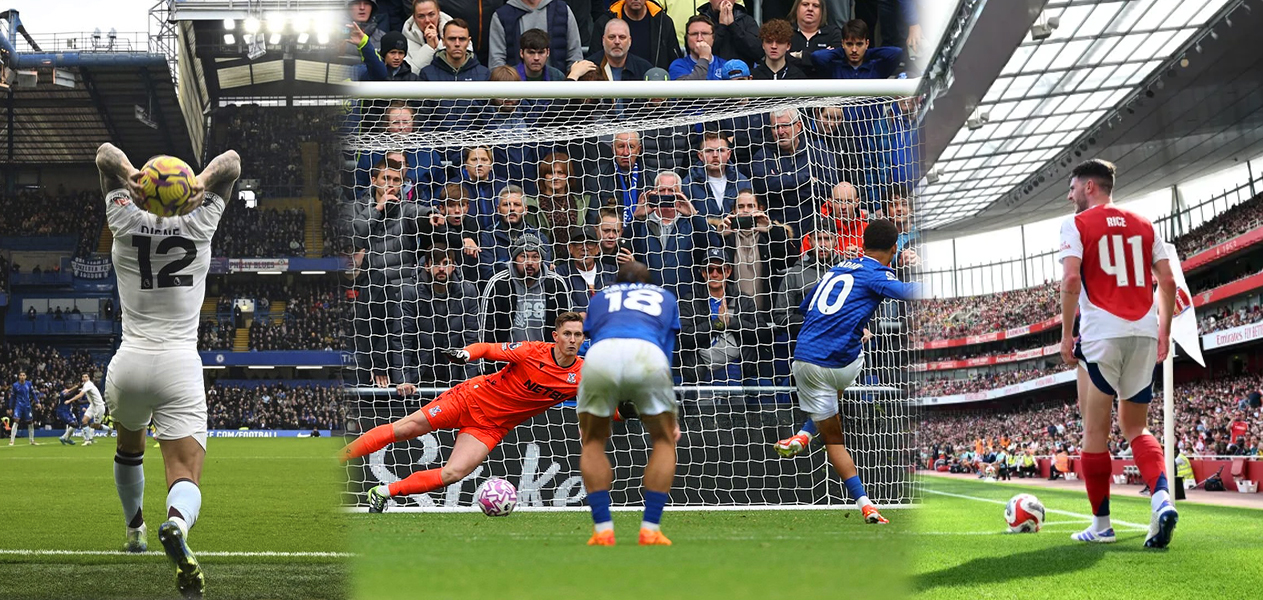
Are we seeing the end of free-flowing football in the Premier League?
The 2025/26 season of the English Premier League has brought about a significant tactical shift. From possession-based and fluid football that was attractive to watch, most teams have now shifted to a more physical and direct style of play.
However, this isn’t a sudden change, but rather a consequence of the previous few seasons, which saw an exponential growth in more and more goals being scored through set pieces as compared to open play.
The smaller teams in the league, who lack technical players as compared to their richer counterparts, seem to be moving towards this pragmatic style more, finding it more effective and easier to follow when compared to being outplayed by superior opponents. That said, top teams like Arsenal, Chelsea, and Manchester United have also benefited from this style of football.
Does this mean that the Premier League has chosen substance over style? And will this mark the end of free-flowing football in the most competitive league in the world?
To answer this question, here we look at the shift in tactics, as well as the numbers supporting it.
Shift in tactics and the trending patterns
As avid football fans, many prefer to watch free-flowing, end-to-end, entertaining football, where two teams play without fear and showcase their exceptional skills on the ball in an attempt to outperform each other.
If we look elsewhere, LaLiga was always the one where football was played more technically (case in point, Barcelona’s tiki-taka style), while the Premier League always had a mix of physical and technical football. Teams under managers like Sam Allardyce and Tony Pulis preferred direct football, relying on long throws, corners, and long balls lumped over the top of the opposition players to create goal-scoring chances.
However, since the arrival of Pep Guardiola and Jürgen Klopp in the Premier League in the last decade, a different, more exciting brand of football became the norm. While Guardiola preferred possession-based football, Klopp popularised a more high-pressing, high-intensity brand of tactics to the league. With their teams achieving sustained success, many other Premier League teams took note and followed suit.
Coming to the present, though, the 2025/26 season has seen a massive shift, with many teams going back to direct football. Disruptive tactics have gained serious momentum, where opposition players are stopped by tackles and fouls to prevent free-flowing moves.
In particular, defending Premier League champions Liverpool have suffered due to this sudden shift, as their technical players, hired primarily for possession-based football, have been suffering and performing poorly. Additionally, teams like Tottenham Hotspur and Manchester City have also not looked at their best.
The current points table suggests that the league has become more competitive, but that has arrived on the back of tighter games, fewer goals scored per game, drab draws, disruptions, and generally boring football.
Supporting stats
If we look at the numbers, it’s quite evident that direct play is resulting in more goals than open play this season. For instance, promoted side Leeds United have been the most successful team when it comes to scoring from set pieces, having scored 14 goals, followed by Arsenal (13), Manchester United (13), and Chelsea (12). The likes of Sunderland and Newcastle United have also scored a significant number of goals from dead-ball situations.
Clearly, it’s not just the newly promoted sides and mid-table teams who are benefiting from direct play; teams in the top half are also employing such tactics, indicating an inclination towards direct play and an over-reliance on set pieces rather than open play.
Another stat of note is the increase in the number of long throws into the penalty box this season. As compared to the 2023/24 and 2024/25 seasons, this term has seen a staggering rise. In 2023/24, there were a total of 558 long throws that averaged to 1.47 throws per game. In 2024/25, this number rose marginally to 578, with an average of 1.52 long throws per game. This season, there have already been 359 long throws, with an incredible average of 3.99 per game.
Brentford, Crystal Palace, Bournemouth, and Sunderland have been using long throws with a lot of success. Antoine Semenyo, Michael Kayode, Nordi Mukiele, and Chris Richards are all great exponents of launching decent balls into the penalty box.
Another noteworthy trend this season has been goalkeepers preferring to go long. With more teams opting for ball-playing goalkeepers in recent years, the last few seasons saw keepers making short passes to their defenders. However, this season has seen a change here as well. Though these numbers were observed very early on, the rise from 40% in 2024/25 to about 48% in 2025/26 indicates how much more commonplace long balls from keepers have been this time around.
Conclusion
Of course, results matter the most in football. At the top level, in the most competitive league in the world, with a lot of money at stake, achieving success is paramount. Consequently, finding effective ways to counter defensive tactics becomes the topmost priority for any coach.
However, football as a sport should also be free-flowing and aesthetically pleasing. As a purist, having admired the skills of Ronaldinho, Ronaldo, Messi, Neymar Júnior, and now Lamine Yamal, fluid and high-intensity football is still the one I would prefer to watch, as opposed to uninspiring, insipid performances.
To move to a more direct style, one involving set pieces, disruptions, and low blocks, seems like not evolution, but regression. This kind of style was understandable in the early years of the previous decade, given the comparative lack of resources among the non-Big Six sides, but given the growth of English football, varied tactics, and the introduction of new technology since then, football ought to be a mix of fluid football intermingled with set-piece effectiveness.
Instead, it’s becoming predictable, slow, and disruptive, taking away the joy of watching games. Open-play goals are drying up, teams are setting up not to lose rather than being creative and adventurous in front of goal, and technical players are being overshadowed by more physical players who don’t possess as much quality but can win duels and indulge in tactical fouls to prevent free-flowing moves.
The Premier League table does show teams bunched closer, hinting at a neck-and-neck battle for the title and European places come the end of the season, but what can also be seen is football that has been quite dreadful, barring a few exceptions. Recent fixtures from Gameweeks 19 and 20 have seen the same patterns, the same reliance on long throws, corners, and long balls forward, and many of them have ended in draws.
It can’t be said definitively as to whether this trend will continue for the long term, just like how for years teams tried to emulate and take inspiration from Pep Guardiola’s style. But if it does, it may prove to be detrimental to the quality of the league and push many of the next generation of fans away, who would rather watch other, more exciting leagues.
Being the most followed league in the world, the Premier League has some expectations fans want delivered consistently — at least from the top teams, if not the mid- and lower-table ones. Only time will tell what the future may bring, but for now, watching Premier League football hasn’t been a very pleasant experience, and I hope things soon change for the better.