
The fading echo of leather on willow
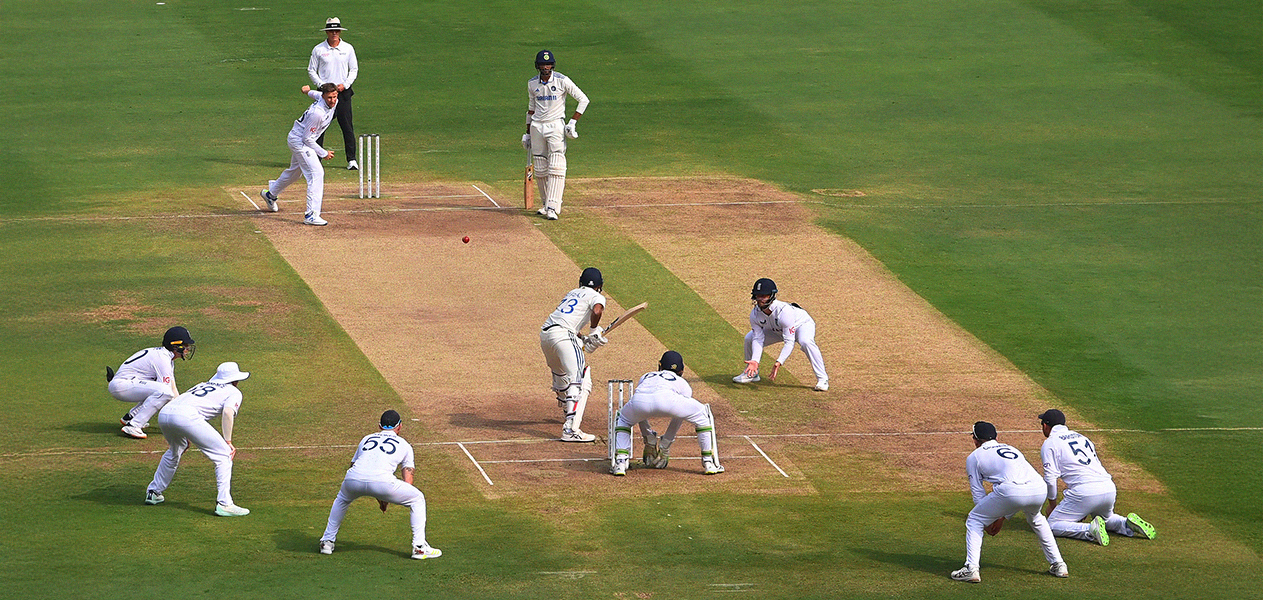
“The good old days,” that’s the thought that pops into my head as I recall many of the iconic cricketing moments from my childhood sitting in a rather quiet corner of the cricketing world, a space where the echoes of leather on willow once resonated for days on end.
Look around. Can you hear it? The gentle thud as a batsman leans into a forward defence, the sharp crack as a cover drive pierces the infield, the satisfying sigh of a fielder taking a catch in the slips after hours of unwavering concentration. This, my friend, is the real essence of red-ball cricket. It is the purest, some might say even the most demanding, form of our beloved game.
But lately, hasn’t it felt…different? Like an old melody slowly being drowned out by a newer, more vibrant tune? Everywhere you look, the cricketing landscape is ablaze with the adrenaline rush of T20 and the rapidly evolving dynamism of T10 tournaments. The stadiums are packed, the music is pumping, and boundaries are raining down like confetti. It’s exhilarating, it’s captivating, and it’s undeniably the flavour of the moment.
I look at the calendar, and it’s just packed. A new T20 league seems to be popping up in a new part of the world every other month. And why not? It’s a fantastic spectacle, it brings in the crowds. And for a young player, the opportunities are just incredible. A few good games, a decent contract, and suddenly a young boy from a small town can become a star.
It’s a beautiful thing. It’s a powerful magnet. Why would a young player choose to spend five gruelling days in a first-class match instead, grinding out a fifty on a tough pitch, when the same effort in a few hours could get him noticed and earn him a life-changing contract? The incentive structure has changed, and we can’t fault the players for following it. It’s a natural evolution.
Yet, as we revel in this era of high-octane cricket, a nagging question lingers in the air, a whisper carried by the wind across these often sparsely populated grounds hosting lower-league domestic white-ball matches: what about Test cricket, and the domestic red-ball structures that feed its very soul? Is the art of patience, of strategic accumulation, of wearing down opponents over five long days, fading away?
According to a 2022 report by the Federation of International Cricketers’ Associations (FICA), 49% of the world’s top T20 players were ready to ditch their national contracts if they were paid more to play in domestic leagues. This exponential growth signifies where the primary focus and financial incentives now lie for many players.
And it’s not just the quantity. It’s the pull. The allure. For a young cricketer starting their journey, the promise of a lucrative T20 contract, the instant fame, the opportunity to rub shoulders with international stars in high-profile tournaments, all make for an incredibly powerful magnet. Why toil away in the relative anonymity of domestic red-ball cricket, honing your defence and learning the nuances of bowling long spells, when the shortest format offers a quicker route to recognition and financial security?
We also see this reflected in player development pathways. Academies and junior setups, while still paying lip service to the fundamentals of Test cricket, are increasingly tailoring their training regimes towards the skills demanded by the shorter formats: explosive power-hitting, clever variations in bowling, and lightning-fast fielding.
The emphasis is on instant impact, on delivering those crucial match-defining moments that can swing a T20 game. The patient accumulation of runs, the strategic building of an innings, the subtle art of setting up a batsman over multiple overs, skills that are the bedrock of red-ball success, are not being nurtured with the same intensity.
Let’s consider the viewership figures as well. While Test cricket still holds a certain prestige and attracts dedicated followers, the numbers pale in comparison to the massive audiences that tune in for T20 matches both franchise and international. Broadcasters, naturally, follow the eyeballs, and the advertising revenue follows the broadcasters. This results in more resources and airtime being devoted to the shorter formats, further pushing red-ball cricket into the shadows.
Recent studies by leading sports marketing agencies indicate that, while viewership for Test matches — excluding marquee series — has remained largely stagnant or even declined in some regions, that of T20 matches has risen rapidly across the world.
And what about the players themselves? The physical and mental demands of Test cricket are immense. Five days of relentless scrutiny, the constant ebb and flow of momentum, the need to adapt to changing conditions, the mental fortitude to overcome periods of struggle, all call for a special kind of resilience and dedication.
In a world where players are increasingly mindful of their workload and longevity, the shorter formats offer a less physically taxing and often more immediately rewarding career path. We’ve seen a growing number of players, even those who have shown promise in red-ball cricket, choosing to specialise in the white-ball game, prioritising franchise cricket over the longer, more demanding format.
Let’s delve into some harsh statistical realities. Look at the number of first-class matches being played outside of the major Test-playing nations. In many emerging cricketing countries, the focus is almost entirely on developing T20 capabilities to compete on the global stage. The investment in robust domestic red-ball structures, the kind that are crucial for nurturing Test cricketers, is often lacking.
According to the International Cricket Council’s development reports, the number of sanctioned first-class matches played by associate members has actually decreased in recent years, while the number of T20 tournaments has multiplied.
Even within established Test nations, the scheduling squeeze is evident. With packed international calendars and the ever-expanding window for franchise leagues, finding dedicated time for meaningful domestic red-ball competitions is becoming increasingly challenging. Often, these tournaments are relegated to less prominent times of the year, played in front of empty stands, sometimes even clashing with more glamorous T20 events, further diluting their importance and visibility.
The impact on skill development is also a serious concern. T20 cricket demands improvisation, innovation, and a high-risk, high-reward approach. While these are valuable attributes, they can sometimes come at the expense of the fundamental techniques and patient approach essential for success in red-ball cricket.
Batsmen who are constantly looking to clear the boundary may struggle to build a long innings through careful accumulation under challenging conditions, while bowlers who mostly rely on variations and deception in T20s often lack the stamina and the ability to consistently hit their areas over extended spells required in Test matches.
There’s also the psychological impact of red-ball cricket. Test cricket is as much a mental battle as it is a physical one. It demands resilience, concentration, and the ability to handle pressure over long periods. The shorter formats, with their rapid pace and instant gratification, can sometimes detract from the development of these crucial mental attributes. Players who are accustomed to the constant adrenaline rush of T20 may find it challenging to adapt to the slower, more strategic rhythm of Test cricket, where patience and mental fortitude are paramount.
Of course, it’s not all doom and gloom. Test cricket still holds a special place in the hearts of many purists, and there are ongoing efforts to preserve and promote it. The World Test Championship is an attempt to add further context and meaning to bilateral Test series. Some boards are making efforts to improve scheduling and market their domestic red-ball competitions. And there are still young cricketers who dream of donning the white and representing their country in the longest format.
But the landscape has fundamentally shifted. The economic realities of the modern game, the demands of the audience, and the preferences of many players have tilted the balance firmly in favour of the shorter formats. The sheer volume and popularity of T20 — and now T10 tournaments — cannot be ignored. They are here to stay, and they will continue to shape the future of our beautiful game.
Perhaps it’s not a case of one format entirely replacing the other. Maybe it’s about finding a way for them to coexist, for the skills and values of red-ball cricket to continue enriching the shorter formats, and for the thrill and excitement of T20 to perhaps even draw a new generation of fans to the broader game, including its more traditional forms.
But, as I look out at this quiet ground, with the shadows lengthening and the day drawing to a close, I can’t help but feel a pang of nostalgia for a time when the red ball held centre stage, when the five-day narrative unfolded with its own unique rhythm and drama, when the ultimate test of a cricketer’s skill and temperament was measured not in boundaries struck but in long innings and wickets earned through perseverance.
That’s the thing about this beautiful, old game. It is not just about runs and wickets. It’s about time. It’s about patience. It’s about life itself, played out over five days on a 22-yard strip of green. The T20 format is a fleeting, dazzling romance, the ODIs a solid, predictable marriage, but a Test match? Ah, that is the full, messy, glorious biography of a life.
Think about the first morning. The sun is out, the pitch is fresh and firm, and the new ball, a perfect cherry, is swinging and seaming. There’s an optimism that hangs in the air, a sense of limitless possibility. Isn’t that exactly how we start our own journeys? Full of energy, full of ambition, with the world laid out before us like an untroubled batting paradise. The initial boundaries are glorious, the confidence absolute. We feel invincible, believing every shot will come off.
But then, as the days wear on, the easy rhythm fades. The pitch, once so reliable, starts to misbehave. The ball gets scuffed and old, and the opposition finds its groove, setting a suffocating field. Suddenly, it’s not about flamboyance anymore. It’s about survival. It’s about patience, about the lonely, difficult grind of building an innings.
This is the middle passage of life, isn’t it? When the initial sparkle has worn off, and you must dig in. You learn to leave the deliveries that aren’t for you, to defend tirelessly, to take the single rather than the six. The scoreboard might not look spectacular, but every single run represents a triumph of resolve over circumstance.
And then, the unexpected happens. A flash of brilliance from a young spinner, a ball that turns and bounces just a little more, or a moment of madness and a reckless shot. A life, like an innings, can turn on a dime. A wicket falls, a partnership breaks, and the momentum shifts, leaving you to rebuild from scratch. You face the very real threat of defeat, and every new batsman, every new challenge, is a test of character, not just of skill.
The final day arrives, and the game’s true colours are revealed. It is no longer about winning. It is often about a different kind of victory: a valiant draw, a stubborn refusal to be defeated. The worn-out pitch, the tired bodies, and the tense silence. It is in these moments, with a single wicket separating glory from defeat, that you see the wisdom of age, the quiet acceptance of limitation, a focus on resilience, and the understanding that, sometimes, just staying at the crease is the greatest achievement of all.
Test cricket is not about the instant gratification. It is a meditation on perseverance. And in that way, it is a mirror, showing us that the real beauty of a life, and of a long innings, isn’t in the spectacular moments, but in the enduring spirit that keeps you fighting, even when the deck is stacked against you.
The roar of the T20 crowd is deafening, the lights are dazzling, and the pace is relentless. But let’s not forget the quiet beauty, the strategic depth, and the enduring legacy of red-ball cricket. Let’s hope that, amid the flashing lights and the frantic energy of the modern game, the echoes of leather on willow continue to resonate — perhaps a little softer, a little further apart, but never completely silenced.
For in those echoes, lies the very soul of cricket.