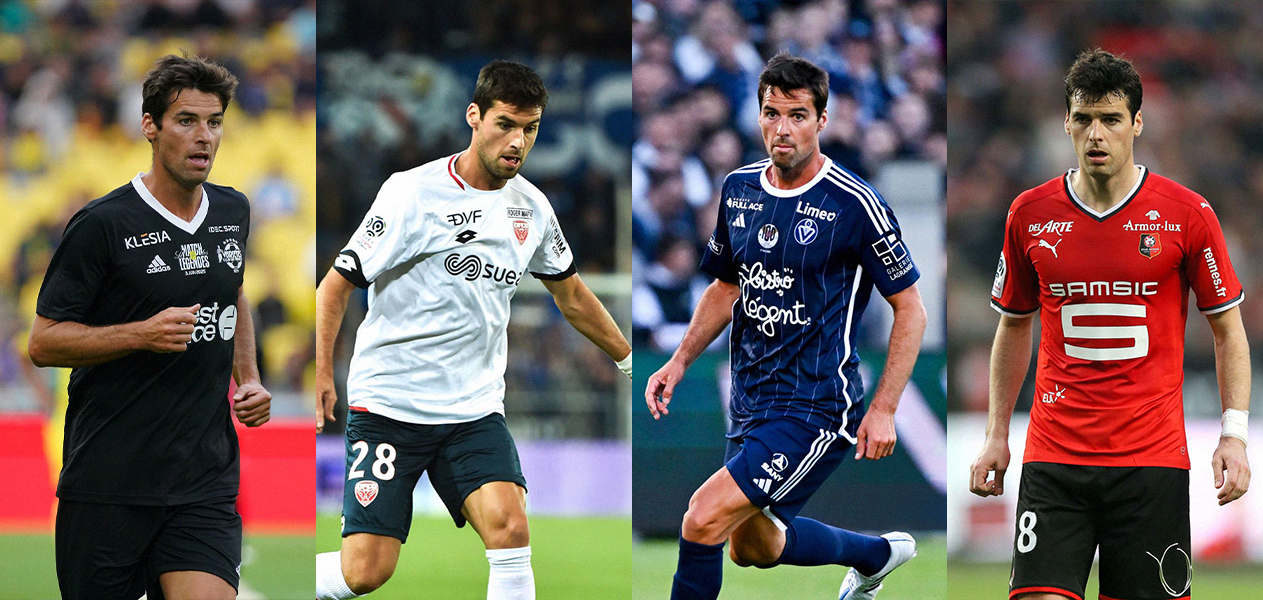
Football's forgotten ballers: Yoann Gourcuff

Football over the years has given us some of the most silken, skilful, elegant, and mesmerising players who have brought a certain joy to the game, making you fall in love with them and, by extension, the sport.
While some stay indelible in the hearts and minds for time immemorial, others slowly and steadily fade away from the public eye, eventually becoming nothing but a footnote in the rich annals of the sport, with their names bringing about a nonchalant shrug or a look of indifference in footballing discourse.
In this series, we look to shed light upon those players who for a brief time shone the brightest in football’s galaxy of stars, threatening to even outshine the biggest of them all at certain stages, only to then fall away, albeit remaining in their own right stars of the game.
Welcome to “Football’s forgotten ballers”, where we roll back the years to bring out a few relatively obscure names and celebrate them for the joy they brought to us, no matter how brief their time in the spotlight was.
For our first baller, we take you to France, to a man who was once christened as the second coming of Zinedine Zidane in his pomp.
We give you: Yoann Gourcuff.
An glitch in the matrix, a joyful anomaly
Gourcuff was born into a family full of athletes, so it was no surprise that sport came to him quite effortlessly. However, it was his father’s (Christian Gourcuff) influence that drew him towards football, despite being equally excellent at tennis. But seeing his father play in the highest echelons of French football piqued his interest, and he decided to walk in his dad’s footsteps.
A big admirer of the Brazil side of the 1970s, Gourcuff made a conscious effort to inculcate the flair and the dynamism of those players, with Pelé being a huge model of inspiration.
With Christian Gourcuff managing Rennes, Yoann decided to walk in the path of his father and joined the club’s academy. He slowly and steadily rose through the ranks before making his professional debut for the first team in January 2004. He kept on making giant strides with Rennes, and the 2005/06 season brought him into the public eye, with his style of play winning him a lot of plaudits and drawing similarities to Zinedine Zidane, who was arguably at the highest point of his career at the time.
AC Milan eventually won the race for his signature, believing that they had found the next talisman to lead their midfield and cement their dominance across the continent. But something about the move did not work. Gourcuff tried hard, but he just did not fit. Whenever he played, it felt like he was walking on eggshells, and his temperament and attitude were always put into question.
Eventually, it came to a point that a move away felt like the only solution for both parties, and off went Gourcuff back to France, moving to Bordeaux.
Little did he know, and little did the world know, about what was going to follow.
At Bordeaux, Gourcuff found favour and love for the game again. He was gliding on the turf like a ballerina, full of elegance and pride. The swagger returned, and so did the flair that made him look more Brazilian than French. He made Bordeaux play along his lines like the Pied Piper, and they followed his example. Les Girondins looked formidable, they looked dangerous. At the helm of it all was Gourcuff, who was now playing like he was ten feet tall, the ball sticking to him like it was in love with him.
And then came the day when Gourcuff made everyone in world football stop whatever they were doing and take notice of him.
It was January 11, 2009. Bordeaux were facing a rather well-stacked and formidable opponent in Paris Saint-Germain. It was supposed to be a test of Bordeaux’s title credentials. Instead, it became the game that announced Yoann Gourcuff to the world.
Wearing No. 8, long sleeves and all, Gourcuff scored the goal that made it 3–0 for Bordeaux. However, it was not just any ordinary goal. It was a goal that made an indelible place for itself in the pantheon of French footballing highlights. It was a goal so eerily magnificent that it might send shivers of excitement down your spine even today.
With his back to goal, two defenders galloping towards him, and with the fluid motion of a river in full flow, Yoann spun between the two like they were non-existent, executing the Marseille turn — or the Zidane turn — with breathtaking perfection. And before the crowd could even fathom the grandeur of his skill, he punctuated it with an outrageous shot from the outside of his boot that rattled into the back of the net before the entire stadium could even gather its senses.
The crowd went berserk, the PSG players were left dumbstruck, and there stood Gourcuff, marvelling at the beauty of his work like Michelangelo admiring David after its completion. Bordeaux won that game 4–0, but this was no ordinary result. It wasn’t even a win that took them to the title. It was the game that elevated Gourcuff from just a normal boy to being “Le Successeur” to Zidane himself.
Such was the magnitude of that goal, it made men feel like little boys. This was what former Bordeaux player Christophe Dugarry had to say in the aftermath of that goal:
“That goal was no accident. It showed there was something magical about him. I felt ill when Zidane retired. Watching Gourcuff has cured me. When I see players like him, I feel like a small boy again.”
Bordeaux went on to secure a domestic double that season, winning Ligue 1 and the Coupe de la Ligue. And Gourcuff went on to win the Player of the Year award, a place in the Ligue 1 team of the season, and a Ballon d’Or nomination, where he finished 20th. He had 12 goals and 12 assists in the league that season, and it finally felt that he would become the player to take the throne Zizou vacated.
Unfortunately for him, and even more unfortunately for French football, Gourcuff was not able to replicate or capture the highs of that season. Injuries, poor form, and multiple skirmishes meant that he drifted into the annals of obscurity, thus becoming French football’s biggest enigma, and a classic case of what could have been.
But for that one season, Yoann Gourcuff was majestic. A Frenchman who danced like a Brazilian, glided like a Spaniard, and mesmerised the world. Elegant, unplayable, and joyfully untouchable when he was on song, he still remains the closest thing the football world has come to having a Zidane replacement, and a forever “the streets will never forget” player.