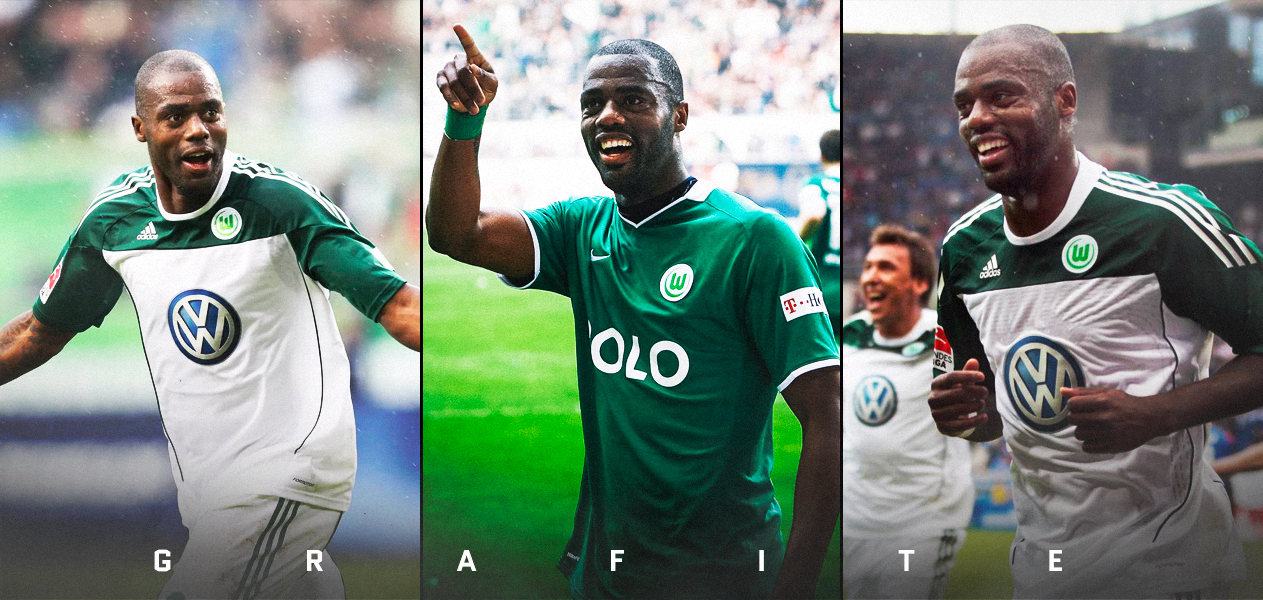
Football's forgotten ballers: Grafite
Our journey to celebrate football’s forgotten ballers continues as we bring forward the accomplishments and skill of those players who shone briefly but brightly, managing to capture the eyes and hearts of fans in that short period of time.
Our first part of the journey took us to France, where Yoann Gourcuff glided and strutted on the world stage for Bordeaux before enigmatically drifting away, though not before reviving the fortunes of a fallen giant.
Our second stop takes us on a short journey to Germany, where a Brazilian striker overcame the odds and his own stature to become one of the Bundesliga’s deadliest hitmen, scoring goals left, right, and centre before fading away as spectacularly as he burst onto the scene.
For our second baller, we bring you Grafite, who plundered goals at will while at Wolfsburg, during what was a fleeting time when he was unparalleled and invulnerable.
How “pencil lead” became a title-winning marksman
Like all Brazilian footballers who have graced the biggest stages in the world, Edinaldo Batista Libanio came from modest upbringings. Selling garbage bags to support his family in order to make ends meet, he found football to be the only saving grace for him and a path to get away from a life of poverty and strife. Fortunately, he was good at it, and that caught the eye of Matonense, who rewarded him with his first contract.
It is here that he got the nickname “Grafite”, which connotatively means “pencil lead” in Portuguese. The nickname stuck to him because of his slender yet towering frame. However, he did not stick around much and kept moving from one club to another, with limited to no success at any of them. A lean stint in South Korea followed, which was then succeeded by a return to his home country in Brazil, playing for Goiás.
It was this stint that saw him recapture his lost favours with the game. A reborn Grafite began to find his scoring touch that seemed to have deserted him. 12 goals for Goiás attracted domestic giants São Paulo, who secured his services, and after another two years of domestic success, it was time for Grafite to take his talents to the European theatre.
Le Mans were the team to win the early race for his signature in 2006. He kept in line with his nomadic journeyman status and stayed there for just a solitary full season, though he impressed nevertheless, adding a further 20 goals to his tally, which did his reputation as a goal-scorer no harm at all and only served to increase it even more. His next move took him to Germany, with Wolfsburg managing to sign him in the summer of 2007.
At that time, Wolfsburg were a pretty controversial side, being one of the clubs not following the 50+1 rule in German football, which made them the pantomime villains for the longest time before RB Leipzig took over that crown in the 2010s.
But despite Volkswagen pumping in the investment, the recent past had not been kind to Wolfsburg. Two successive 15th-place finishes meant that change was needed, and Grafite was one of many names brought in to bolster the side in the hope of taking that step up to challenging for better positions and bigger prizes.
Grafite had a pretty respectable first season for the Wölfe, where he added another double-digit season to his tally, scoring 12 goals in 28 appearances and helping the team seal a spot in the UEFA Cup, now known as the Europa League.
If the first season was a gentle showcase of what he could do, the 2008/09 season witnessed an absolute hurricane of Samba excellence that left German football aghast and bewildered at the sheer scale of excellence that Grafite unleashed.
It was not the best of starts for Wolfsburg. Four wins in their first ten games meant that they were perched in sixth place in the table halfway through the season. However, that did not deter Grafite, who had started the season like a house on fire. Despite managing to play only 13 out of the first 21 games of the season, he kept banging in the goals, scoring 12 of them. He struck an impeccable understanding with his strike partner, a young, unheralded Bosnian called Edin Džeko.
And then, from matchday 19 onwards, Wolfsburg and Grafite both went on an almighty run. In that ten-match winning run, Grafite scored at will, featuring a brace in a 3–1 win over Hamburg, a hat-trick in an all-time classic 4–3 win over Schalke, and a goal against Arminia Bielefeld. But the best was yet to come.
It was the game against Bayern that showcased Grafite at the peak of his scoring prowess. Wolfsburg had the game wrapped up at 4–1. Grafite, already on the scoresheet once, wanted more. Wolfsburg and the Volkswagen Arena wanted more. So he did what only he could do, and he did it with stunning nonchalance.
Receiving the ball in Bayern’s territory, Grafite carried it for ten yards before unleashing his Brazilian DNA in audacious style. He first made a victim out of Andreas Ottl with a turn that probably still haunts the German in his dreams. He then danced past Christian Lell, left Philipp Lahm, compatriot Breno, and goalkeeper Michael Rensing in his wake. With his back to goal, just when it felt like the move had passed him by, he added the crème de la crème to top it all off. With Bayern bodies all around, he unfurled a backheel with so little power that the ball went into the back of the net like it had a mind of its own, with its speed seemingly taunting and teasing the helpless Bayern players.
Such was the goal that Fritz von Thurn und Taxis, who was commentating that game, went on to say, “This is definitely the goal of the season, if not the best goal I have ever seen since the Bundesliga started in 1963.” Andrea Barzagli, Grafite’s teammate at the time, went on to say that he “was blowing it from the back” so that it would go in.
That goal not only heralded Wolfsburg’s eventual canter to the title — their only one to date — it also catapulted Grafite’s rise to superstardom on the world stage. Grafite helped himself to 28 goals for the season, and his goal was nominated for the inaugural Puskás Award, eventually finishing third in the rankings. He won the Germany Player of the Year award, an accolade no one could argue with. He even went on to bag a hat-trick in his first Champions League appearance, becoming one of only nine players to achieve this feat.
A call to the Brazil side for the 2010 FIFA World Cup followed, but that was the end of Grafite’s ascent. His slide after his heroics at Wolfsburg was gradual, and after a spell in the Middle East, he eventually slipped out of public view, never to be seen again.
This was the tale of Grafite, the boy who was christened “pencil lead”, who was as sharp a goalscorer as one could imagine. Well-travelled, but a little misunderstood.